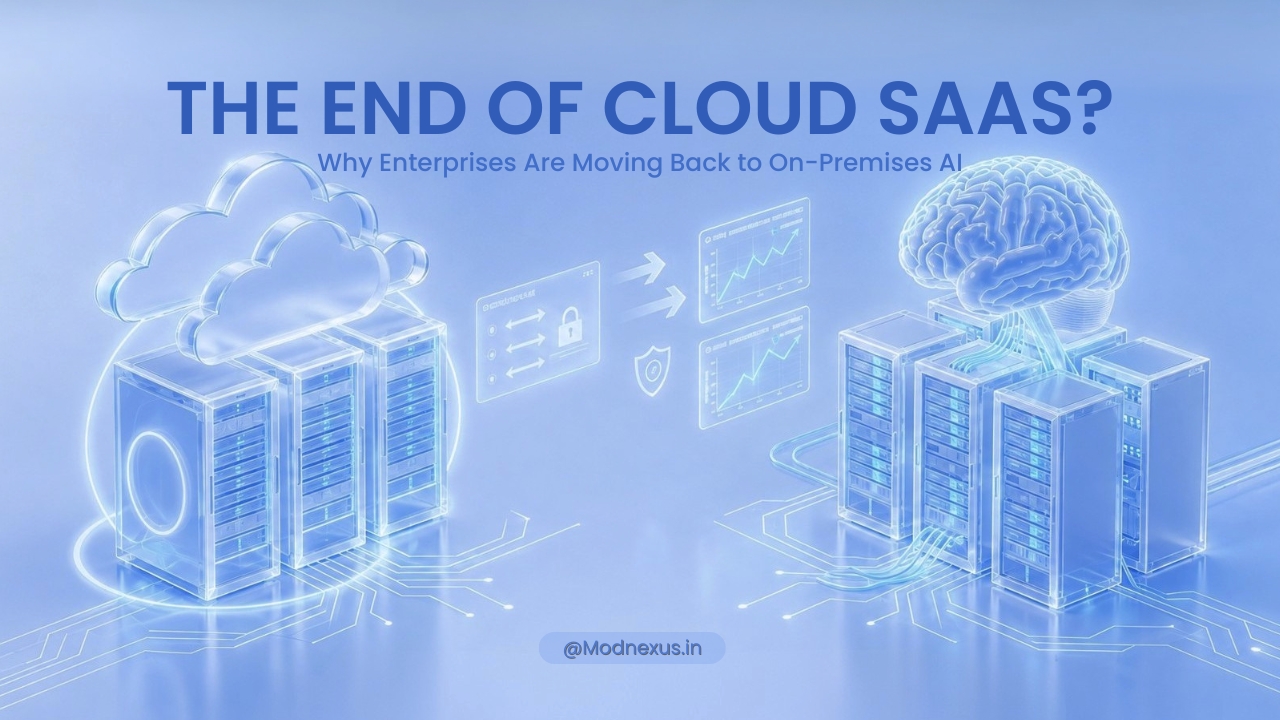
Cloud Software as a Service (SaaS) has been one of the defining technologies of enterprise digital transformation.
For more than a decade, organizations moved CRM, ERP, HR, collaboration, analytics and customer-support applications into the cloud because the economic proposition was compelling. Instead of purchasing servers, maintaining data centers and managing software upgrades internally, businesses could subscribe to technology and access it from anywhere.
Cloud SaaS transformed IT from an infrastructure-heavy function into a service-oriented model.
But artificial intelligence is changing the economics.
AI workloads are fundamentally different from many traditional SaaS applications. They can consume large amounts of compute, process substantial volumes of data, generate continuous inference requests and require specialized hardware.
An employee using a traditional SaaS application might create a database transaction.
An AI assistant might trigger multiple model calls, retrieve documents, generate embeddings, process a large context window and execute several tools before returning a single response.
At enterprise scale, those interactions can create a significant recurring infrastructure cost.
This has led CTOs, CIOs and technology leaders to reconsider an assumption that became almost universal during the cloud era:
Does every AI workload actually belong in the public cloud?
Increasingly, the answer is no.
The emerging strategy is not necessarily a return to traditional on-premises IT. Instead, enterprises are building hybrid AI architectures in which cloud SaaS continues to support applications that benefit from elasticity and managed infrastructure, while selected AI workloads run on private or on-premises infrastructure.
The objective is not to eliminate the cloud.
It is to run each workload where it makes the most technical and economic sense.
To understand why organizations are reconsidering cloud infrastructure for AI, it is important to understand why cloud SaaS became so successful.
Before SaaS, businesses often needed to purchase and maintain:
physical servers;
networking equipment;
storage systems;
enterprise software licenses;
backup infrastructure;
security systems;
data-center facilities;
specialized IT personnel.
Software deployment could take weeks or months.
Cloud SaaS changed that model.
Organizations could subscribe to applications and receive:
rapid deployment;
automatic updates;
centralized maintenance;
remote accessibility;
elastic capacity;
predictable subscription structures;
reduced infrastructure management.
For traditional enterprise applications, this remains extremely valuable.
A company generally does not need to own the servers running its CRM system.
The same applies to collaboration platforms, email, project-management applications and many other business systems.
Cloud SaaS effectively allowed businesses to outsource a large portion of infrastructure complexity.
The challenge is that AI introduces a different cost structure.
AI is computationally intensive.
A conventional SaaS application may process structured records and execute relatively predictable transactions.
An AI system can continuously perform:
model inference;
document processing;
embeddings;
semantic search;
classification;
summarization;
image analysis;
speech processing;
agent orchestration;
tool execution.
Consider a customer-support agent.
A customer asks a question.
The AI system may:
Receive query → authenticate user → retrieve customer information → search knowledge base → generate context → call LLM → execute tool → call LLM again → generate final response
One customer interaction may therefore generate multiple computational operations.
Now multiply that by:
100,000 customers;
thousands of employees;
multiple departments;
thousands of documents;
millions of API calls.
The economics change rapidly.
This is why enterprises are beginning to distinguish between cloud application infrastructure and AI compute infrastructure.
They may continue running the application in the cloud while moving selected AI workloads closer to their data and users.
SaaS subscriptions are often easy to justify individually.
A company may pay for:
CRM;
ERP;
HRMS;
accounting;
collaboration;
project management;
customer support;
analytics;
cybersecurity;
AI assistants.
Each subscription may appear reasonable.
The problem is cumulative recurring expenditure.
AI adds another dimension because some AI services are usage-based.
Instead of paying only a fixed monthly subscription, organizations may also pay according to:
API calls;
tokens;
compute;
storage;
embeddings;
vector search;
GPU usage;
data processing.
The more employees use AI, the more workloads increase.
The more customers interact with AI, the more inference increases.
The more documents the company processes, the more AI compute is required.
This creates an important distinction:
Traditional SaaS costs are often primarily subscription-driven.
AI infrastructure costs can become strongly consumption-driven.
That distinction becomes particularly important at enterprise scale.
When calculating cloud AI expenditure, organizations often focus only on the LLM API bill.
That is rarely the complete picture.
A production AI system can also require:
The cost of generating responses.
Required for semantic search and many RAG systems.
Used to retrieve relevant enterprise information.
Documents, datasets, logs and generated content all require storage.
Documents may need OCR, parsing, transformation and indexing.
Large-scale AI applications can generate substantial data movement.
Enterprise systems require observability and logging.
Identity, access control, encryption and security monitoring add operational costs.
Agentic workflows can involve multiple model and tool calls.
AI applications require ongoing development, evaluation and maintenance.
Consequently, the real question is not:
“How much does our LLM API cost?”
It is:
“What is the total cost of operating our AI platform?”
There are four major reasons organizations are evaluating private and on-premises AI.
High-volume workloads can make recurring inference expenditure significant.
Sensitive information may require tighter control over where data is processed.
Some AI applications require extremely low and predictable latency.
Organizations may want to reduce dependence on a single AI provider.
These factors do not mean cloud AI is becoming obsolete.
They mean that cloud-only AI is no longer automatically the best architecture for every workload.
Data is often the strongest reason for considering on-premises AI.
Enterprise AI applications may process:
customer financial information;
healthcare records;
legal documents;
source code;
product designs;
engineering documentation;
intellectual property;
employee information;
confidential contracts.
Organizations may have contractual, regulatory or internal policy requirements governing how such information is processed.
An on-premises AI environment can provide greater control over:
network boundaries;
data storage;
model execution;
access permissions;
logging;
retention;
encryption;
infrastructure configuration.
However, an important distinction must be made:
On-premises does not automatically mean secure or compliant.
Security depends on how the infrastructure is designed and operated.
A poorly configured private AI environment can still create significant risk.
The advantage is that the organization has greater direct control over the environment.
Another concern is vendor dependency.
Suppose an enterprise builds its entire AI platform around one cloud provider’s proprietary:
model APIs;
vector database;
agent framework;
orchestration;
storage;
monitoring;
workflow system.
After several years, the organization may discover that migrating away requires significant engineering.
This is vendor lock-in.
The problem is not necessarily the provider itself.
The problem is excessive architectural dependence.
A more resilient enterprise architecture separates:
Business Logic
from
AI Infrastructure
from
Model Providers
This allows organizations to change components independently.
An enterprise could therefore maintain:
Cloud SaaS → AI Gateway → Model Router → Local / Private / Cloud Models
This creates flexibility without abandoning cloud infrastructure.
For some workloads, milliseconds matter.
Consider:
robotics;
manufacturing quality inspection;
industrial automation;
predictive maintenance;
real-time document processing;
edge AI;
security systems.
Sending every request to a remote cloud service can introduce network latency and dependency on internet connectivity.
Local inference can reduce the distance between:
Data → Compute → Decision
This is particularly important when AI must operate in real time.
Imagine a manufacturing camera inspecting products on a production line.
The system may need to identify defects immediately.
Sending every image to a remote cloud service may introduce unnecessary latency, bandwidth usage and operational dependency.
A local inference system can process the data closer to the production line.
The cloud can still be used for:
centralized reporting;
analytics;
model training;
fleet management;
historical analysis.
This is an example of why edge + on-premises + cloud can coexist in the same enterprise architecture.
On-premises AI means that AI models and supporting infrastructure are deployed within infrastructure controlled by the organization.
That could include:
GPU servers;
private data centers;
enterprise server rooms;
private cloud environments;
edge computing systems.
A typical architecture could look like:
Enterprise Application
↓
AI Gateway
↓
Inference Infrastructure
↓
Local Model
↓
Enterprise Data
The organization manages the environment rather than outsourcing the entire inference layer.
This provides greater control but also greater responsibility.
The organization must manage:
hardware;
networking;
security;
deployment;
monitoring;
updates;
capacity planning;
backups;
disaster recovery.
That operational burden is one of the biggest trade-offs.
One of the strongest arguments for on-premises AI is cost predictability.
Suppose a manufacturer knows it will process millions of similar AI requests every month for the next five years.
Instead of paying indefinitely for every API call, the organization can evaluate the economics of purchasing infrastructure capable of handling that workload.
The company pays for:
hardware;
electricity;
maintenance;
engineering;
replacement.
But once the infrastructure exists, additional inference may have a significantly different marginal cost compared with paying an external API for every request.
This is particularly attractive when utilization is high.
The critical word is:
utilization.
A GPU sitting idle does not generate economic value.
A GPU processing workloads continuously can potentially provide strong economics.
Therefore:
On-premises AI is most attractive when workloads are large, predictable and sustained.
Consider a manufacturing organization using AI across:
predictive maintenance;
quality inspection;
document processing;
internal knowledge management;
customer support.
Suppose its cloud-based AI expenditure is ₹5 lakh per month.
That represents:
₹5 lakh × 12 = ₹60 lakh annually.
The organization may consider investing ₹50 lakh in GPU infrastructure.
A simplistic calculation suggests that the infrastructure could approach payback in less than one year.
But a responsible CTO should immediately add:
electricity;
cooling;
maintenance;
engineering;
software;
monitoring;
redundancy;
hardware depreciation;
backup infrastructure;
disaster recovery.
The company must also consider whether the locally deployed models deliver comparable performance.
The real calculation is therefore:
Cloud TCO vs. On-Premises TCO vs. Hybrid TCO
over a three-to-five-year period.
That is a much more meaningful business comparison.
The most practical answer for many enterprises is not:
Cloud or on-premises.
It is:
Cloud and on-premises.
A hybrid architecture can place each workload in the environment best suited to it.
For example:
Customer-facing SaaS applications
Elastic workloads
Advanced AI models
Rapid experimentation
Global applications
Sensitive internal data
High-volume inference
Real-time manufacturing AI
Internal knowledge systems
Predictable workloads
Robotics
Computer vision
Industrial inspection
Low-latency decision-making
This approach avoids the false choice between cloud and local infrastructure.
A modern enterprise could build something like:
Employees / Customers
↓
Cloud Applications
↓
Enterprise API Layer
↓
AI Gateway
↓
Model Router
↙︎ ↓ ↘︎
On-Prem AI | Private Cloud AI | Public Cloud AI
↓
Enterprise Data + Business Systems
The AI gateway becomes a strategic control point.
It can determine:
which model handles the request;
where data is processed;
which users have access;
which workloads require human approval;
how much a request costs;
whether a fallback model should be used.
This architecture also reduces the risk of building the entire business around one AI provider.
Manufacturing is one of the strongest candidates for hybrid AI.
Consider a company operating multiple production facilities.
Its AI applications might include:
machine failure prediction;
quality inspection;
worker assistance;
technical document search;
inventory optimization;
maintenance recommendations.
Some workloads are highly repetitive and predictable.
Others require advanced reasoning.
A hybrid model could therefore use:
On-Premises AI
for real-time machine and quality inspection.
Local RAG
for technical documentation.
Cloud AI
for complex engineering analysis.
Cloud SaaS
for centralized dashboards and collaboration.
This architecture reduces the need to send every piece of operational data to a remote AI service.
It also allows each plant to maintain AI capabilities even if network connectivity becomes unreliable.
Banks process highly sensitive information.
AI applications may include:
customer-service automation;
document analysis;
fraud investigation;
compliance assistance;
internal knowledge search;
employee copilots.
A hybrid architecture can separate these workloads.
For example:
Internal policy search
→ private or on-premises AI.
High-volume classification
→ specialized local model.
Advanced research
→ controlled cloud AI.
Customer-facing application
→ cloud infrastructure with appropriate security controls.
The advantage is that the organization does not have to treat every AI workload identically.
Risk and architecture can be aligned.
Healthcare organizations are another important use case.
AI systems may process:
clinical documentation;
medical records;
administrative documents;
patient communication;
internal research;
operational information.
For highly sensitive workloads, organizations may prefer infrastructure with greater control over data processing.
On-premises or private AI can therefore become part of a broader security architecture.
However, healthcare AI also demonstrates why infrastructure alone is insufficient.
Organizations must consider:
data governance;
access control;
auditability;
human oversight;
model validation;
clinical safety;
applicable regulations.
The model’s hosting environment is only one part of responsible AI deployment.
Law firms and legal departments manage confidential documents that may contain:
contracts;
litigation materials;
intellectual property;
merger information;
financial records;
privileged communications.
AI can help with:
contract review;
document summarization;
legal research;
clause extraction;
knowledge management.
For organizations with strict confidentiality requirements, private AI infrastructure can be attractive.
A local model can process internal documents without automatically sending the underlying document contents to an external AI provider.
However, firms should still implement appropriate security, access controls and governance.
Pharmaceutical companies operate with highly valuable intellectual property.
AI workloads may include:
research-document analysis;
scientific literature search;
internal knowledge systems;
drug-development workflows;
manufacturing optimization.
The cost of intellectual-property leakage can be significantly greater than the cost of AI infrastructure.
For these organizations, the economic equation may therefore include a value that is difficult to express as a simple API cost:
Control over strategic information.
That can make private AI infrastructure strategically attractive even when cloud AI is not necessarily more expensive.
Logistics companies increasingly use AI for:
route optimization;
demand forecasting;
warehouse operations;
fleet maintenance;
customer support;
document processing.
Some workloads require centralized cloud analytics.
Others can benefit from local or edge processing.
For example, warehouse computer-vision systems can process camera feeds locally rather than continuously transmitting high volumes of video data to the cloud.
The cloud can receive only:
alerts;
summaries;
metrics;
selected events.
This can reduce bandwidth requirements while improving response time.
One of the reasons on-premises AI has become more practical is the growth of capable open-weight model ecosystems.
Organizations can evaluate models from multiple providers and communities rather than relying exclusively on proprietary APIs.
Models such as Llama and Mistral have contributed to the broader availability of deployable language models, while the wider ecosystem includes models specialized for:
coding;
reasoning;
multilingual applications;
document processing;
embeddings;
vision;
speech.
This creates a new possibility.
The enterprise can choose the model according to the workload.
However, CTOs should carefully evaluate:
model license;
commercial-use terms;
hardware requirements;
benchmark performance;
security;
update frequency;
community support;
fine-tuning requirements.
“Open source” and “open weight” are also not interchangeable terms, so legal and procurement teams should verify licensing before production deployment.
Historically, enterprise IT infrastructure centered around CPUs.
AI changes that.
Modern AI workloads can require:
GPUs;
AI accelerators;
high-bandwidth memory;
high-speed networking;
optimized storage.
This means AI infrastructure increasingly resembles a specialized compute platform.
For enterprises considering on-premises AI, hardware selection should be based on:
model size;
quantization;
context length;
concurrent users;
latency requirements;
throughput;
memory requirements;
redundancy;
future model upgrades.
Buying the most powerful GPU available is not necessarily the correct decision.
The correct hardware depends on the workload.
The case for local AI should not become an argument for ignoring operational complexity.
On-premises AI creates responsibilities that cloud providers normally absorb.
The organization must potentially manage:
Procurement, replacement and failures.
AI servers can consume substantial electricity.
High-density GPU systems create significant heat.
AI infrastructure can require high-speed internal networking.
Models need to be installed, configured and updated.
Performance and failures need to be tracked.
The environment needs appropriate protection.
Teams must maintain the AI platform.
Organizations must anticipate future demand.
Therefore, local AI is not simply a cost-saving strategy.
It is a technology operating model.
One of the simplest ways to evaluate on-premises AI is to estimate utilization.
Imagine two companies each purchase ₹50 lakh of GPU infrastructure.
Company A uses its infrastructure continuously.
Company B uses it only during a few hours each day.
Company A is likely to extract significantly more value from the investment.
Company B may have been better served by elastic cloud infrastructure.
This is why CTOs should model:
average utilization;
peak utilization;
concurrent requests;
daily workload;
seasonal workload;
expected growth.
The question is not:
“Can we run the model locally?”
It is:
“Can we keep the infrastructure economically productive?”
A serious infrastructure decision should not be based on one month’s bill.
Compare the options over multiple years.
Include:
AI API costs;
compute;
storage;
vector databases;
networking;
monitoring;
supporting SaaS;
engineering.
Include:
GPU servers;
networking;
storage;
power;
cooling;
maintenance;
engineering;
software;
monitoring;
hardware replacement;
redundancy.
Include both infrastructure categories while accounting for reduced cloud AI consumption.
Then calculate:
Cost per AI task
Cost per user
Cost per successful workflow
Cost per document
Cost per customer interaction
These metrics make the comparison much more meaningful.
This is perhaps the biggest misconception.
The enterprise AI movement is not necessarily:
Cloud → On-Premises
It is:
Cloud-Only → Workload-Aware Architecture
Some workloads should remain in the cloud.
Some should run privately.
Some should run locally.
Some should run at the edge.
Some should use traditional software instead of AI.
The architecture should be determined by:
Cost + Security + Performance + Scalability + Business Value
rather than ideology.
Start by creating an AI workload inventory.
For every AI application, record:
What does the AI actually do?
How many requests occur each month?
What information does it process?
How quickly must it respond?
Does it need frontier-level intelligence?
How predictable is the workload?
What happens at 5× or 10× scale?
What happens if the AI system is unavailable?
What does the workload cost today?
This creates a factual basis for infrastructure decisions.
Organizations do not need to move everything at once.
A safer approach is incremental.
Identify all AI workloads and their costs.
Divide workloads into:
Cloud
Private
On-Premises
Edge
Select one high-volume, predictable workload.
Compare cloud and local performance.
Measure:
cost;
accuracy;
latency;
reliability;
utilization.
Move the workload only if the business case is positive.
Continuously monitor infrastructure utilization and model performance.
This reduces migration risk.
One of the most important components in a modern hybrid AI architecture is the AI gateway.
Instead of applications calling models directly, requests pass through a controlled layer.
The gateway can provide:
model routing;
authentication;
authorization;
rate limiting;
logging;
cost tracking;
policy enforcement;
fallback models;
provider abstraction.
For example:
Employee asks a question
↓
AI Gateway
↓
Is the data sensitive?
↓
Yes → Local Model
No → Is advanced reasoning required?
↓
Yes → Cloud Model
No → Cost-optimized Model
This architecture provides flexibility as the organization’s AI portfolio evolves.
Cloud SaaS changed the question from:
“Where is our server?”
to:
“Which service are we subscribing to?”
AI is now adding another question:
“Who controls the intelligence processing our business data?”
For some businesses, the answer will remain a cloud provider.
For others, it will be a private infrastructure environment.
For many enterprises, it will be both.
The strategic advantage comes from having the architectural flexibility to decide.
The cloud remains fundamental to modern enterprise IT.
Businesses will continue using cloud platforms for:
collaboration;
CRM;
ERP;
analytics;
customer applications;
global infrastructure;
elastic computing.
The change is happening specifically around AI workloads.
Enterprises are realizing that AI compute has different economics and operational requirements.
That creates a new architecture:
Cloud SaaS + Cloud AI + Private AI + On-Premises AI + Edge AI
Each layer performs the workloads for which it is best suited.
This is a more mature approach than simply declaring that everything should be cloud or everything should be local.
Before investing in local AI infrastructure, ask:
What is our current monthly AI expenditure?
Which workloads generate the majority of that cost?
What will our AI usage look like at 5× and 10× scale?
Are our workloads predictable?
What percentage can smaller models handle?
Which workloads contain sensitive information?
What latency requirements do we have?
Do we have GPU infrastructure expertise?
What is our expected GPU utilization?
Have we calculated electricity and cooling?
Have we included engineering costs?
What is the three-year TCO?
What is the five-year TCO?
Do we require cloud fallback?
Can our applications switch between models?
Do we have an AI gateway?
Are model performance benchmarks available?
Can we monitor cost and utilization?
Do we have disaster-recovery plans?
Does the architecture support future AI models?
If the answers show high volume, predictable utilization, sensitive data and strong internal infrastructure capabilities, on-premises AI deserves serious consideration.
If demand is unpredictable and frontier-model performance is critical, cloud AI may remain the better option.
For many enterprises, the result will be hybrid.
Cloud SaaS is not disappearing.
The cloud remains one of the most important foundations of modern enterprise technology.
What is changing is the assumption that every AI workload should automatically run in the same environment as the rest of the organization’s software.
AI introduces different requirements.
Inference can be computationally expensive.
Data can be highly sensitive.
Latency can matter.
Workloads can become enormous.
And recurring AI consumption can create costs that scale with business adoption.
This is why enterprises are increasingly evaluating on-premises and private AI infrastructure alongside cloud services.
The objective is not to replace the cloud.
It is to build a workload-aware AI architecture.
Cloud infrastructure can continue powering customer-facing applications, collaboration, analytics and elastic workloads.
On-premises AI can handle high-volume, sensitive or latency-critical workloads.
Edge AI can process real-time industrial data.
Private AI environments can provide additional control for regulated applications.
And an AI gateway can connect these environments while giving the enterprise centralized governance and model-routing capabilities.
The companies that succeed with enterprise AI will not necessarily be the companies that choose the cheapest model or the newest infrastructure.
They will be the companies that understand their workloads well enough to deploy AI in the environment that delivers the best combination of:
Cost. Security. Performance. Control. Scalability.
At ModNexus, we help organizations evaluate AI infrastructure based on business requirements rather than technology trends. Whether the right solution is cloud AI, on-premises AI, private infrastructure or a hybrid architecture, the goal is the same: build an AI environment that can scale with the business without creating unnecessary cost, complexity or dependency.
The future of enterprise AI isn’t cloud versus on-premises.
It’s choosing where each AI workload creates the most value.