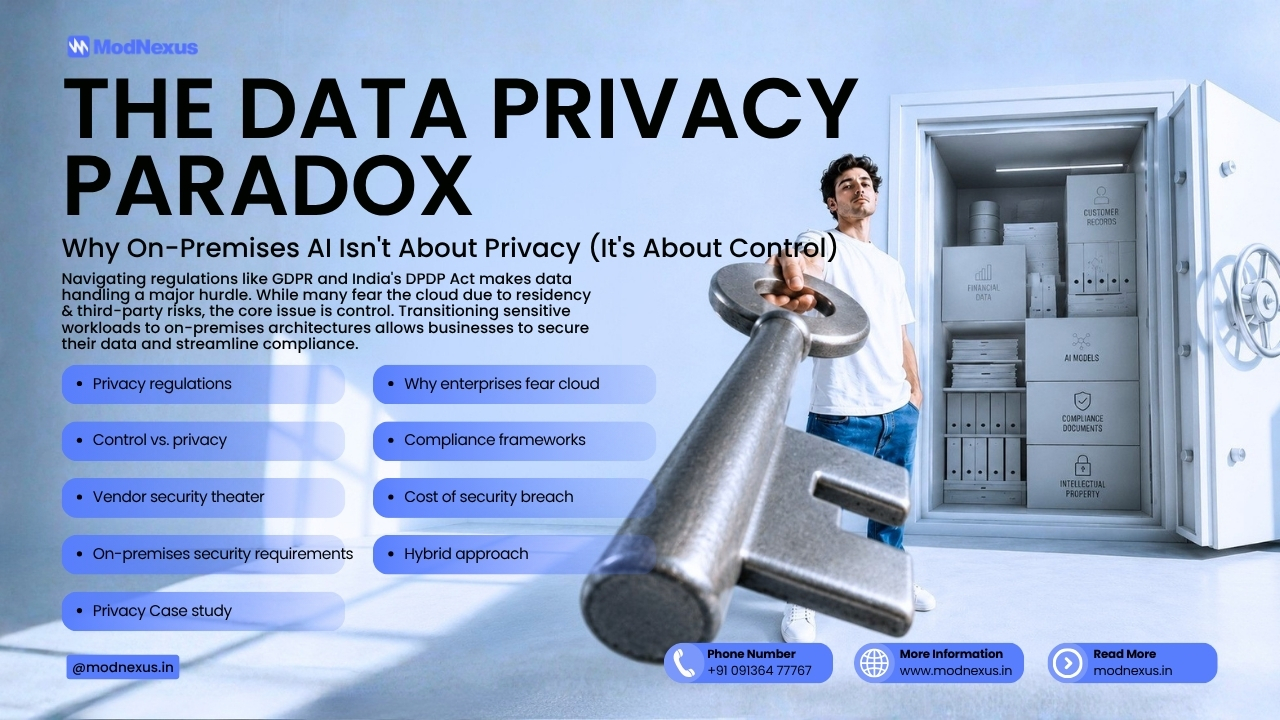
Artificial intelligence has moved from experimentation to enterprise infrastructure.
Companies are using AI to analyze contracts, summarize financial records, search internal knowledge bases, automate customer support, review technical documents, assist employees and make operational decisions. But as AI moves deeper into business processes, one question is becoming harder for CIOs, CTOs and CISOs to avoid:
Where does your company’s data actually go when you use AI?
The conventional answer is often, “We use a secure cloud provider.”
That answer is not necessarily wrong. Modern cloud platforms have sophisticated encryption, identity management, monitoring, threat detection and compliance programs. Google Cloud, for example, offers technologies such as Confidential Computing that protect data while it is being processed, not only while it is stored or transmitted.
But enterprise AI introduces a different question.
It isn’t simply: “Is my data private?”
It is: “Who controls my data, my AI environment, my access policies, my infrastructure and ultimately my data’s destiny?”
That distinction is the heart of the on-premises AI debate.
On-premises AI does not magically make an organization secure or compliant. Poorly configured infrastructure can be less secure than a well-managed cloud environment.
The real advantage is control.
And for organizations operating under strict regulatory, contractual or internal security requirements, control can be more valuable than privacy alone.
On-premises AI refers to artificial intelligence infrastructure that is deployed and operated within an organization’s own controlled environment.
Instead of sending sensitive information to an external AI service, an organization can deploy:
inside its own data center, private infrastructure or dedicated controlled environment.
For example, a financial institution could deploy an internal AI assistant that searches policies, customer-service procedures and internal documentation without sending the underlying knowledge base to a public AI endpoint.
A manufacturer could deploy an AI system that analyzes engineering drawings, maintenance records and proprietary product specifications.
A healthcare organization could create an AI workflow around sensitive operational data while keeping the data environment under its own governance.
The important distinction is not simply where the AI model runs.
It is who controls the complete data path.
That includes: Data → preprocessing → model → prompts → inference → logs → outputs → storage → backups → access
With on-premises AI, the organization can design and govern that entire chain.
Cloud AI providers can offer excellent security.
In fact, many large cloud providers invest significantly more in cybersecurity infrastructure than an individual enterprise could realistically afford.
So saying: “Cloud is insecure and on-premises is secure” is an oversimplification.
The more accurate argument is:
Cloud security can be extremely strong, but on-premises infrastructure can provide greater organizational control over where sensitive data is processed, who can access it, how it is retained and how the AI system is governed.
This distinction becomes important during audits.
Imagine an auditor asks:
A cloud architecture may have good answers.
An on-premises architecture may give the enterprise direct authority over many of those answers.
That is control.
AI doesn’t operate outside existing privacy law.
Organizations deploying AI must consider the legal requirements that apply to the personal data they collect, process, store or transmit.
The European Union’s General Data Protection Regulation (GDPR) remains one of the most influential data-protection frameworks globally.
The European Commission highlights principles including data minimization, purpose limitation and accountability. Data minimization means organizations should limit personal data collection to what is relevant and necessary for the intended purpose.
This becomes particularly important with generative AI.
A company may technically be able to send an entire database to an AI model.
But the better question is: Does the AI system actually need all of that information?
If an employee asks an internal AI assistant to summarize a contract, does the model need access to every customer record? Probably not.
This is where privacy-by-design, access control, data minimization and AI architecture intersect.
For Indian businesses, the Digital Personal Data Protection Act, 2023 (DPDP Act) is a major consideration.
The legislation establishes a framework governing the processing of digital personal data in India.
The Government of India subsequently notified the DPDP Rules, 2025, creating a more detailed operational framework around the Act.
For enterprises adopting AI, this means data governance cannot remain an afterthought.
Consider an AI-powered customer-service system.
It might process:
If that information is flowing through multiple external systems, the organization’s governance responsibility becomes more complex.
An on-premises AI architecture can simplify some aspects of the data-flow model by keeping sensitive processing within a controlled infrastructure boundary.
However, on-premises deployment does not automatically equal DPDP compliance.
Organizations still need appropriate policies, access controls, security measures, retention practices, incident response, governance and documentation. That distinction is critical.
Global enterprises face an increasingly fragmented privacy environment.
In the United States, for example, California’s privacy regime gives consumers additional rights concerning their personal information. The California Attorney General’s office describes the CCPA as giving consumers greater control over personal information collected by businesses.
Other U.S. states have also introduced privacy laws with different requirements and definitions.
For multinational organizations, the result can be complicated:
One AI system may process data governed by multiple regulatory regimes.
This makes data classification and architectural boundaries increasingly important.
Instead of treating every piece of data identically, enterprises can classify information into categories such as:
Low-risk information that can safely be processed through approved cloud services.
Business information requiring controlled access.
Sensitive commercial, operational or customer information.
Highly sensitive financial, personal, health, intellectual-property or regulated information.
The AI architecture can then reflect those classifications.
That leads naturally to the next concept:
Hybrid AI.
The concern isn’t necessarily that cloud providers are careless.
The concern is that the enterprise is introducing another party into its data-processing chain.
A cloud AI architecture may involve:
Enterprise → Cloud infrastructure → AI platform → Model → Logs → Monitoring → Backups
Every additional component requires governance.
Enterprise security teams may therefore ask:
Data residency can matter when contractual or regulatory requirements specify geographic processing or storage boundaries.
Enterprises need to understand identity, administrative access, support access and privileged operations.
AI systems can generate highly sensitive prompts.
A prompt might contain: “Analyze this customer’s financial history and determine why the account was flagged.”
That prompt itself may be sensitive.
Logs are frequently forgotten.
An organization may protect the primary database while unintentionally storing sensitive information in:
The AI security model therefore needs to consider the entire lifecycle of the data.
This is where the discussion often becomes unnecessarily ideological.
Cloud isn’t automatically insecure.
On-premises isn’t automatically secure.
The difference is control architecture.
A cloud provider can provide:
Google Cloud, for example, describes Confidential Computing as a way to protect data while it is being processed, extending protection beyond data at rest and in transit.
This demonstrates an important point: Cloud security is evolving rapidly.
Therefore, enterprises shouldn’t choose on-premises AI simply because they believe “cloud equals insecure.”
Instead, the decision should be based on:
risk + regulation + data sensitivity + operational control + cost + business requirements.
Enterprise vendors frequently promote security certifications and compliance programs.
These are valuable.
But there is an important distinction between: “The vendor has strong controls.”
and “The enterprise controls the environment.”
ISO/IEC 27001, for example, is a globally recognized standard for information security management systems (ISMS). It provides requirements for establishing, implementing, maintaining and continually improving an organization’s information security management system.
SOC 2 similarly evaluates controls related to areas such as security, availability, processing integrity, confidentiality and privacy.
These frameworks are extremely useful.
But certification does not mean: “You can stop managing security.”
It means the organization or service provider has implemented controls against defined requirements.
Enterprises still need to understand:
This is why AI vendor due diligence matters.
The strongest argument for on-premises AI isn’t: “Nobody else can ever access the data.”
That claim would be too broad.
The stronger argument is: “We have direct control over the environment in which the data is processed.”
That changes the organization’s ability to enforce policy.
With an appropriately designed on-premises AI system, enterprises can control:
AI infrastructure can be isolated from public networks or placed behind controlled network boundaries.
Only authorized employees, applications or services can interact with the model.
The organization can determine where embeddings, documents, prompts and outputs are stored.
Administrators can control which models are deployed and which teams can use them.
The enterprise can determine what is logged and where those logs are retained.
AI-generated data can follow the organization’s existing retention policies.
The organization can evaluate model versions before deploying them into production.
The organization can reduce dependence on an external AI API for particularly sensitive workloads.
That is what AI data sovereignty looks like in practice.
There is a catch. When you control the infrastructure, you also control the responsibility.
An on-premises AI server with poor security is still a security risk.
Enterprises must therefore implement:
In other words: On-premises AI is not a shortcut around cybersecurity.
It is an architectural choice that gives an enterprise more direct control.
That control has to be used responsibly.
Security isn’t simply an IT expense.
A data breach can affect:
IBM’s 2026 Cost of a Data Breach research reports a global average breach cost of approximately US$4.99 million, illustrating the financial scale of modern data-security incidents.
For a mid-sized Indian organization, even a much smaller incident can represent a serious financial and reputational event.
That’s why the relevant question isn’t: “Is on-premises AI more expensive than cloud AI?”
The better question is: “What is the cost of insufficient control over our most sensitive data?”
For many enterprises, the answer isn’t 100% cloud or 100% on-premises.
It is hybrid AI. A practical architecture might look like this:
Use cloud models for:
Use private infrastructure for:
Place a policy layer between employees and AI models.
The gateway can determine:
What data can go to which model?
For example:
Public document → Cloud AI allowed
Internal document → Approved cloud model
Confidential document → Private AI
Restricted customer data → On-premises AI only
This approach provides the best of both worlds.
Enterprises can still access the scalability and model ecosystem of cloud AI while retaining tighter control over their most sensitive workloads.
Financial services is one of the clearest examples of why AI governance matters.
Banks and financial institutions routinely deal with:
Imagine a bank implementing an AI assistant for its compliance team.
The assistant needs to search thousands of internal documents.
Sending every document to a public AI service may create unnecessary governance complexity.
A private AI deployment could instead create an architecture like:
Internal documents → Secure ingestion → Private vector database → On-premises LLM → Controlled employee interface
The model can answer questions against approved internal information while the organization retains control of the underlying environment.
This isn’t necessarily about replacing every cloud service.
It’s about identifying which workloads deserve stronger control.
Google Cloud’s Confidential Computing technology provides a useful example of how the cloud industry itself is responding to the control problem.
Confidential Computing is designed to protect data while it is being processed, including through hardware-based confidential environments. Google describes this as protecting data in use, complementing traditional encryption of data at rest and in transit.
This is significant because it demonstrates where enterprise security architecture is heading.
The debate is no longer simply:
Cloud vs. on-premises.
It is increasingly about:
Who can access what, under which conditions, at which stage of the data lifecycle?
For some organizations, advanced cloud controls may be sufficient.
For others, particularly those with strict internal requirements, an on-premises environment may still provide the preferred control boundary.
The control conversation is becoming even more important as organizations move from AI experiments to autonomous and agentic systems.
Gartner has predicted that more than 40% of agentic AI projects could be cancelled by the end of 2027 because of escalating costs, unclear business value or inadequate risk controls.
That prediction highlights an important enterprise lesson:
AI adoption without governance creates technology debt.
An AI chatbot answering questions is one thing.
An AI agent that can:
is a completely different security proposition.
The more autonomy an AI system receives, the more important identity, access control, auditability and data boundaries become.
Consider a hypothetical financial-services company with a large internal compliance department.
The organization uses AI to analyze:
Initially, the company uses a cloud AI platform.
The AI performs well, but the compliance team identifies several concerns:
The organization then moves its highest-sensitivity compliance workflows to an on-premises AI environment.
The architecture becomes: Sensitive documents → Internal document repository → Private RAG pipeline → On-premises vector database → Private LLM → Internal compliance portal
The company maintains cloud AI for lower-risk workloads.
As a result, the compliance team can focus its deepest review on a smaller set of external AI dependencies.
For a company with this architecture, it is reasonable to target a significant reduction in the scope of third-party AI processing that auditors need to examine.
For example, a hypothetical 60% reduction in audit scope could occur if the organization successfully moves the majority of sensitive AI processing into a controlled environment.
This 60% figure is an illustrative scenario, not a claim about a specific named financial institution. Actual results depend on the organization’s data architecture, regulatory obligations and audit methodology.
The lesson is more important than the number:
Better architecture can reduce compliance complexity.
On-premises AI deserves serious consideration when several of the following conditions apply:
Financial, legal, healthcare, defense, engineering or proprietary information may require stronger controls.
Financial services, healthcare, insurance and other regulated sectors often have complex governance requirements.
Enterprise customers may require contractual guarantees around data handling.
Some organizations simply don’t permit sensitive information to leave controlled infrastructure.
The more important AI becomes to your operations, the more important architecture, resilience and governance become.
Running private models can reduce dependence on a single AI provider.
On-premises AI requires infrastructure, security and MLOps expertise.
If none of these apply, cloud AI may remain the more practical option.
Before approving an enterprise AI project, ask:
Don’t start with the model.
Start with the data.
Classify it.
Create an actual data-flow diagram.
Include:
Determine which components are operated by your organization and which are operated by third parties.
Your AI architecture should not create an unexpected dependency that becomes impossible to unwind.
Security isn’t only about implementing controls.
It is about being able to demonstrate them to:
That is where frameworks such as ISO/IEC 27001 and SOC 2 become valuable.
The cloud-versus-on-premises argument is becoming outdated.
The future is more likely to be:
Cloud + Private AI + Strong Governance
Enterprises will increasingly decide where workloads should run based on risk.
A simple decision framework could look like this:
| Data Type | Recommended AI Environment |
|---|---|
| Public information | Cloud AI |
| Low-risk internal data | Approved cloud AI |
| Confidential business data | Private cloud / controlled AI |
| Sensitive customer data | Private AI |
| Highly restricted data | On-premises AI |
| Mixed workloads | Hybrid AI |
The objective isn’t to move everything on-premises.
The objective is to put the right data in the right environment.
The biggest misconception about on-premises AI is that companies choose it because cloud AI is inherently unsafe.
That’s not the real argument.
Modern cloud platforms can provide extremely sophisticated security capabilities.
The deeper issue is control over the complete AI data lifecycle.
With on-premises AI, an enterprise can decide:
That level of control can be particularly valuable when AI becomes deeply integrated into sensitive business processes.
Privacy asks:
“Is my information protected?”
Security asks:
“Can unauthorized people access it?”
Compliance asks:
“Can I demonstrate that I’m meeting my obligations?”
But control asks the bigger question:
“Who ultimately determines what happens to my data?”
And that is why the future of enterprise AI isn’t simply about privacy.
It’s about control.
At ModNexus, we help businesses evaluate where AI should run based on their data sensitivity, security requirements, business processes and compliance needs.
An enterprise AI strategy doesn’t have to mean moving everything to a public cloud model.
We can help organizations evaluate:
The objective is simple:
Build AI around your business’s security requirements—not force your business’s sensitive data into an AI architecture that wasn’t designed for it.
We’ll help you identify:
✓ What data your AI systems are processing
✓ Where that data is going
✓ Which workloads should remain private
✓ Where cloud AI can safely be used
✓ Potential governance and security gaps
✓ Opportunities for a hybrid or on-premises AI architecture
Request your free security and AI compliance readiness assessment today.
Not automatically. Security depends on architecture, configuration, monitoring, access controls and operational discipline. On-premises AI’s primary advantage is greater direct control over infrastructure and data flows.
No. GDPR does not simply require organizations to use on-premises infrastructure. Organizations can use cloud infrastructure if appropriate technical, organizational and contractual safeguards are implemented. On-premises deployment may, however, simplify certain data-control and governance requirements depending on the use case.
No. Deploying AI on-premises does not automatically make an organization compliant with India’s DPDP framework. Governance, security safeguards, policies, access controls and other obligations still need to be addressed.
Private AI generally refers to AI systems deployed in an environment where access and data processing are restricted to a specific organization or authorized users. It can include on-premises infrastructure, private cloud environments and other controlled deployments.
It can require significant upfront investment in GPUs, servers, storage, networking and security. However, the economics depend heavily on usage volume, model size, workload requirements and the cost of external AI APIs. For high-volume sensitive workloads, private infrastructure can sometimes make strategic and economic sense.
For many organizations, the answer is hybrid. Low-risk workloads can use approved cloud AI services, while highly sensitive workloads can remain within private infrastructure.
AI data sovereignty refers to an organization’s ability to control where AI-related data is stored, processed and accessed, including the geographic and organizational boundaries governing that data.
The AI security debate is moving beyond:
“Is the cloud secure?”
The more useful enterprise question is:
“What level of control does this AI workload require?”
For some workloads, cloud AI is the right answer.
For others, private or on-premises AI provides a stronger control boundary.
And for many enterprises, hybrid AI will be the practical middle ground.
The winners won’t necessarily be the companies that keep all their AI on-premises.
They’ll be the companies that understand which data belongs where—and why.
Privacy is important. Security is essential. Compliance is mandatory.
But control is what allows an enterprise to manage all three.