Artificial intelligence has moved from research laboratories into boardrooms, customer-service operations, software teams, factories and financial departments.
The arrival of ChatGPT accelerated that transition dramatically.
Within months, generative AI became one of the most discussed technologies in business. Organizations began experimenting with AI copilots, document assistants, customer-service bots, content-generation tools and AI agents.
The excitement is justified—but so is the skepticism.
Many companies have discovered that a successful AI demonstration is not necessarily a successful production system.
A chatbot that answers five questions correctly in a demo may struggle when it receives 50,000 customer queries. A document-processing system may perform well on clean sample documents but fail when real-world PDFs contain missing fields, unusual formatting or poor scans. A coding assistant may increase developer productivity while still requiring human review for security-sensitive code.
This creates an important distinction for enterprise technology leaders:
Generative AI can be extremely valuable in production—but only when it is applied to the right problem and surrounded by the right engineering controls.
The goal should not be to use generative AI everywhere.
The goal should be to identify where it provides a measurable advantage over traditional software, deterministic AI and classical machine learning.
For some use cases, generative AI is the right technology.
For others, a conventional machine-learning model may be cheaper, faster, more predictable and easier to govern.
And for many enterprise applications, the strongest architecture is a combination of both.
The introduction of ChatGPT changed expectations around AI.
People who had never worked with machine learning could suddenly ask an AI system to:
That accessibility created enormous excitement.
Businesses naturally began asking:
“If AI can do all of this, what else can we automate?”
But production environments are fundamentally different from demonstrations.
A demo typically has:
Production systems have:
This is where many generative AI projects encounter difficulties.
Generative AI is particularly powerful when a task requires understanding, transforming or generating unstructured information.
This includes language, documents, code and other forms of content.
Some enterprise applications have already demonstrated strong practical value.
Content generation is one of the most straightforward applications of generative AI.
Businesses can use AI to create first drafts of:
The key is understanding what AI should do.
Instead of expecting the model to independently publish everything, organizations can use it as a content-production assistant.
For example:
Human creates brief
↓
AI generates draft
↓
Business rules validate content
↓
Human reviews
↓
Final content published
This approach combines AI speed with human judgment.
Consider a B2B manufacturer with thousands of products.
Each product may have:
Creating consistent product descriptions manually can take significant time.
A generative AI system can transform structured product data into standardized descriptions.
For example:
Product database
→
AI content generation
→
Technical validation
→
Human approval
→
Website / catalog
The AI is not inventing product specifications.
It is transforming trusted information into useful language.
That distinction dramatically reduces risk.
Software engineering is another area where generative AI has demonstrated significant practical value.
Developers can use AI tools to:
The productivity benefit can be substantial because developers spend significant time on repetitive tasks.
However, generated code should not automatically be treated as production-ready.
AI-generated code can contain:
A production development workflow should therefore look like:
AI generates → Developer reviews → Tests execute → Security checks → Deployment
rather than:
AI generates → Production
Customer service is another area where generative AI can create measurable value.
Traditional chatbots often rely on predefined decision trees.
For example:
“Press 1 for billing.”
“Press 2 for technical support.”
Generative AI can understand natural-language questions.
A customer could ask:
“My invoice shows the wrong amount and I also haven’t received the replacement product you promised.”
A generative AI system can identify multiple intents and retrieve relevant information.
A production architecture might be:
Customer Query
↓
Intent Detection
↓
Knowledge Retrieval
↓
LLM
↓
Business Rules
↓
Response or Human Escalation
This is much safer than allowing an LLM to independently invent answers.
Imagine an industrial equipment company supporting thousands of customers.
Customers ask about:
Instead of training a model to memorize everything, the organization can connect the LLM to an approved knowledge base.
The system retrieves relevant documentation before generating a response.
This approach—often called Retrieval-Augmented Generation (RAG)—can improve factual grounding.
The model becomes a reasoning and communication layer over trusted enterprise information.
Generative AI has impressive capabilities, but it is not a deterministic database query engine.
One of its biggest characteristics is that it generates probable responses rather than guaranteeing factual correctness.
That creates several production challenges.
A hallucination occurs when an AI model generates information that sounds plausible but is incorrect or unsupported.
For example, a customer asks:
“What is the warranty period for this machine?”
If the relevant warranty information isn’t available, an unrestricted model might produce a plausible-sounding answer.
In a production environment, this can be dangerous.
The consequences could include:
For high-risk use cases, organizations need mechanisms such as:
The goal isn’t to pretend hallucinations don’t exist.
The goal is to design the system so hallucinations cannot easily become business actions.
Generative AI can produce excellent answers and still fail on edge cases.
A model might correctly answer 98 out of 100 common questions.
That sounds impressive.
But if the remaining two questions involve:
then a 98% success rate may not be acceptable.
Enterprise AI therefore requires use-case-specific evaluation.
The relevant question is not:
“Is this model intelligent?”
It is:
“Is this system accurate enough for this specific business task?”
Generative AI can appear inexpensive during experimentation.
A team may spend a few thousand rupees testing an API.
But production usage can be dramatically larger.
Imagine an enterprise with:
Thousands or millions of model calls can accumulate over time.
Depending on model choice, prompt size, output volume, architecture and usage patterns, enterprise generative AI expenditure can potentially reach ₹5 lakh, ₹20 lakh, ₹50 lakh or more annually.
The exact cost varies substantially, so organizations should model actual token consumption rather than relying on simple monthly estimates.
The cost equation includes more than the LLM API.
You may also pay for:
This is why cost per successful business outcome is often a better metric than cost per API call.
Generative AI isn’t always instantaneous.
A production workflow might involve:
User Request
↓
Authentication
↓
Data Retrieval
↓
Vector Search
↓
LLM Request
↓
Tool Call
↓
Second LLM Request
↓
Response
Each additional step can add latency.
For applications where users expect near-instant responses, this can become a significant design problem.
For example, an internal research assistant may tolerate several seconds.
A real-time industrial control system may not.
This is another reason why architecture matters as much as model selection.
Enterprise AI frequently involves sensitive information.
Examples include:
Sending this information to an external AI API may introduce security and compliance considerations.
Organizations need to understand:
The answer depends on the provider, configuration and applicable regulations.
For sensitive workloads, companies may consider:
The right answer depends on the organization’s risk profile.
This is perhaps the most important lesson for CTOs.
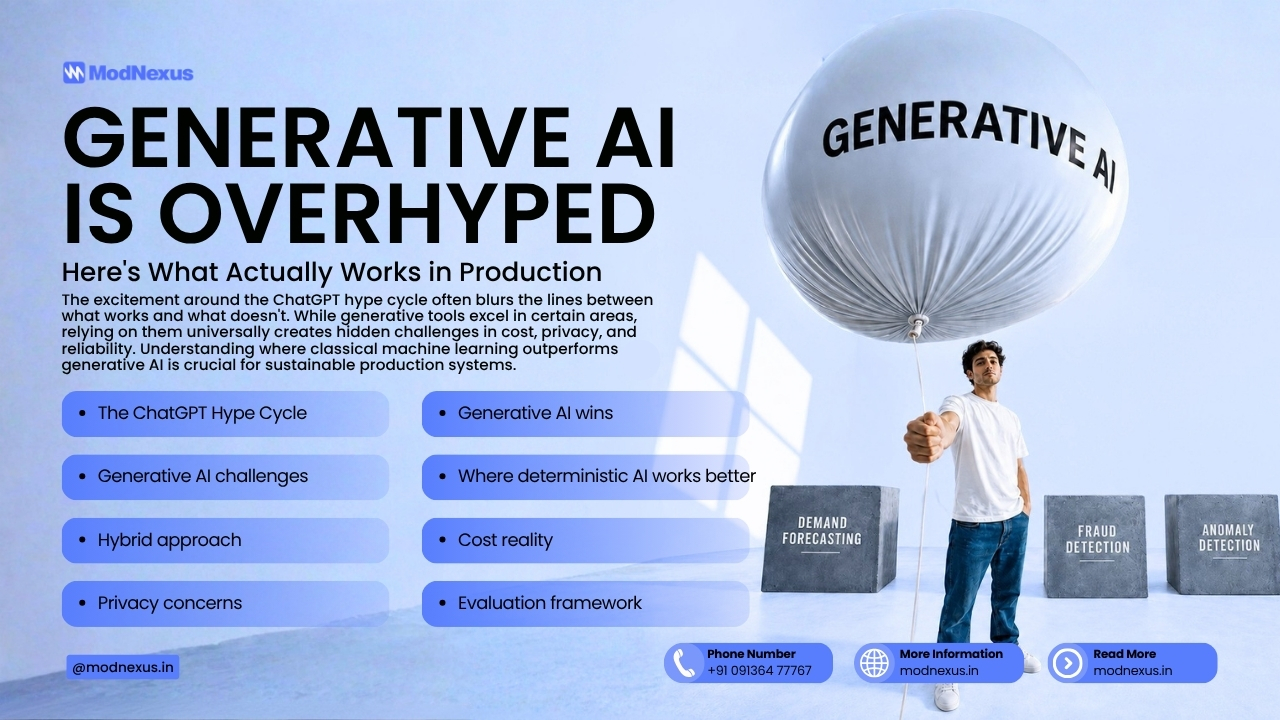
Some problems are better solved using classical machine learning.
Consider demand forecasting.
The objective is to predict:
How many units will we sell next week?
A forecasting model can analyze:
A specialized forecasting model may be more appropriate than asking a generative language model to make the prediction.
Similarly, fraud detection is often better suited to classification and anomaly-detection techniques.
This is because these problems have structured inputs and measurable outputs.
Traditional machine learning remains extremely valuable.
Examples include:
Predict future sales.
Identify suspicious transactions.
Identify unusual machine behavior.
Predict equipment failures.
Estimate probability of default.
Identify manufacturing defects.
Predict which products a customer may purchase.
Identify customers likely to leave.
These applications often benefit from models specifically designed for numerical and structured prediction.
The model doesn’t need to write an essay.
It needs to produce a reliable prediction.
Imagine a factory monitoring 500 machines.
Sensors generate:
The objective is:
Predict which machines are likely to fail.
A classical anomaly-detection or predictive-maintenance model may be highly effective.
A generative AI model isn’t necessarily required to predict failure probability.
However, generative AI can become useful after the prediction.
For example:
ML Model
→ Machine failure probability: 87%
↓
Generative AI
→ Explains the issue to the maintenance engineer in natural language.
↓
Automation
→ Creates maintenance ticket.
This is the power of a hybrid architecture.
Consider a bank monitoring millions of transactions.
A machine-learning model can identify:
A classification or anomaly-detection model can produce a risk score.
Generative AI can then assist investigators by summarizing the case.
For example:
“This account shows three unusual transactions compared with its previous 90-day pattern.”
The deterministic model performs the detection.
The generative model performs the explanation.
Each technology is doing what it is best suited for.
The strongest enterprise AI systems increasingly combine multiple approaches.
A simplified architecture can look like:
Classical ML
→ Prediction
↓
AI Rules / Decision Engine
→ Business validation
↓
Generative AI
→ Explanation / interaction
↓
Automation
→ Execution
For example:
ML predicts demand.
Calculates required stock.
Explains the recommendation.
Creates the procurement workflow.
This is considerably more robust than asking an LLM to do everything.
This principle is extremely useful in enterprise architecture.
The LLM can be the interface between humans and business intelligence.
But the underlying source of truth should remain structured systems.
For example:
ERP
→ Actual inventory
CRM
→ Customer information
Data Warehouse
→ Historical performance
ML Model
→ Forecast
Rules Engine
→ Business constraints
LLM
→ Natural-language explanation
This reduces the risk of allowing generated text to become the authoritative business record.
Retrieval-Augmented Generation can help address some of the limitations of general-purpose LLMs.
Instead of relying entirely on the model’s internal knowledge:
User Query
↓
Search Enterprise Knowledge
↓
Retrieve Relevant Documents
↓
LLM Generates Answer
The knowledge source can include:
This is particularly useful for enterprise knowledge assistants.
However, RAG is not a magic solution.
The system still needs:
Poor retrieval can still produce poor answers.
A production AI system should not rely solely on model intelligence.
It needs engineering controls.
Important safeguards include:
Check what information enters the system.
Ensure users can only retrieve information they are authorized to access.
Restrict answers to approved information sources where appropriate.
Require the model to return information in predictable formats.
Prevent AI from violating operational constraints.
Route uncertain cases to humans.
Allow complex or high-risk cases to be reviewed.
Track performance after deployment.
Maintain records of important AI decisions and actions.
This is what turns an AI experiment into an enterprise system.
Not every AI decision should be fully autonomous.
A useful framework is to divide tasks by risk.
AI can operate with limited supervision.
Examples:
AI recommends; humans approve.
Examples:
AI assists but humans make the final decision.
Examples:
This approach allows organizations to gain AI productivity while maintaining appropriate governance.
Before selecting a model, ask several questions.
If you’re dealing with:
generative AI may be useful.
If the system needs to:
an LLM may be appropriate.
If the goal is:
classical ML may be better.
If incorrect outputs could create serious financial, legal or safety consequences, deterministic controls and human review become increasingly important.
Calculate expected:
Requests × Tokens × Model Price
Then include infrastructure and operational costs.
| Business Problem | Likely Best Starting Point |
|---|---|
| Document summarization | Generative AI |
| Customer FAQ | RAG + Generative AI |
| Code assistance | Generative AI |
| Product description generation | Generative AI |
| Demand forecasting | Classical ML |
| Fraud detection | Classical ML |
| Predictive maintenance | Classical ML |
| Anomaly detection | Classical ML |
| Knowledge assistant | RAG + Generative AI |
| Risk scoring | Classical ML |
| AI-powered workflow | Hybrid AI |
| Complex enterprise agent | Generative AI + ML + Automation |
The important phrase is “best starting point.”
Architecture should ultimately be determined through evaluation rather than assumptions.
A common mistake is to ask:
“How much does an AI API cost?”
A better question is:
“How much does it cost to successfully complete the business task?”
Consider a customer-service AI system.
Suppose an AI interaction costs ₹2.
That sounds inexpensive.
But if the AI successfully resolves only 60% of cases and the remaining cases require human intervention, the real cost is higher.
Compare that with a system costing ₹3 per interaction but successfully resolving 85%.
The second system may generate greater economic value.
Therefore, organizations should track:
This provides a much more realistic picture of ROI.
Consider a logistics company processing thousands of delivery-related customer requests.
Generative AI can handle:
“Where is my shipment?”
But shipment status should come from the company’s tracking system—not from the LLM’s knowledge.
A robust architecture is:
Customer
↓
LLM understands request
↓
Tracking API provides shipment status
↓
LLM explains status
↓
Customer receives response
The LLM handles language.
The logistics platform remains the source of truth.
This is exactly where generative AI works well in production.
A pharmaceutical organization may use AI to search internal documentation, summarize research and assist employees.
Generative AI can help employees find information across large document collections.
But high-risk conclusions should remain subject to:
The same principle applies across regulated industries:
Use generative AI where language intelligence creates value, but don’t allow generated content to bypass established controls.
The biggest problem is often not the model.
It is the system around the model.
Common causes include:
The model receives incomplete or unreliable information.
Teams deploy without defining what “good” means.
Usage grows without monitoring.
The AI cannot access the systems required to complete the task.
The system is forced to answer everything.
Performance degradation goes unnoticed.
Generative AI is used for a problem better suited to classical ML.
This is why successful enterprise AI requires AI engineering, data engineering, security and business-process design—not simply an API call.
Organizations can reduce risk by introducing AI gradually.
Start with a measurable business challenge.
Not:
“We want to use generative AI.”
Instead:
“We want to reduce customer-service handling time by 30%.”
Determine whether it primarily involves:
Use:
Classical ML for structured prediction.
Generative AI for language and unstructured information.
RAG for enterprise knowledge.
Automation for deterministic workflows.
Hybrid systems for complex processes.
Test the solution against real business data.
Measure:
Introduce:
If the system produces measurable ROI at pilot scale, expand it.
This avoids turning an interesting AI experiment into an expensive enterprise platform without a clear business case.
The next stage of enterprise AI will likely be less about choosing one technology and more about building the right combination.
A sophisticated enterprise architecture may contain:
Classical ML
for prediction.
Generative AI
for language.
RAG
for enterprise knowledge.
Rules engines
for deterministic business constraints.
AI agents
for multi-step reasoning.
Automation
for reliable execution.
Humans
for judgment, governance and accountability.
This layered approach is much more realistic than expecting one model to solve every problem.
The companies that benefit most from AI will not necessarily be those that deploy the largest models.
They will be the organizations that understand where intelligence creates economic value.
A manufacturer may gain more value from predictive maintenance than an AI chatbot.
A bank may gain more value from fraud detection than content generation.
A logistics company may gain more value from route optimization than a general-purpose AI assistant.
A B2B software company may gain significant value from AI-assisted development and customer support.
The technology should follow the business problem—not the other way around.
Generative AI is neither a miracle technology nor a useless hype cycle.
It is a powerful new layer of computing that is particularly effective at understanding and generating unstructured information.
It can help businesses:
But production AI requires more than a powerful model.
Organizations must account for:
And most importantly, businesses should recognize that not every AI problem requires generative AI.
Demand forecasting, fraud detection, anomaly detection and predictive maintenance may often be better served by classical machine-learning techniques.
The strongest enterprise architecture combines the technologies.
Classical ML predicts.
Generative AI communicates and reasons over unstructured information.
RAG connects AI to trusted enterprise knowledge.
Rules enforce business constraints.
Automation executes predictable processes.
Humans provide oversight where judgment matters.
That is what practical AI in production looks like.
At ModNexus, we help organizations evaluate AI opportunities based on business value, technical feasibility, security and long-term economics—not simply the latest AI trend.
If your organization has several AI ideas but isn’t sure which ones are actually viable, start with the highest-value opportunities rather than implementing AI everywhere.
Identify your top 3 AI use cases and evaluate them across business value, technical feasibility, data readiness, risk, implementation complexity and expected ROI.
The objective isn’t to ask:
“Where can we use ChatGPT?”
The better question is:
“Where can AI create a measurable competitive advantage for our business?”
That is the question that turns AI from hype into production value.