AI has moved from experimentation to a serious enterprise investment. Organizations are now using artificial intelligence for customer service, document processing, sales automation, software development, forecasting, knowledge management, fraud detection, quality control and decision support.
But there is a problem that is becoming increasingly important for CTOs, CIOs and business leaders:
What happens when the AI technology you selected today is no longer the best option tomorrow?
Foundation models are evolving rapidly. New reasoning models, smaller language models, multimodal systems, agent frameworks, embedding technologies and AI infrastructure platforms continue to emerge. At the same time, model pricing, context capabilities, latency and deployment options can change significantly.
For an organization investing ₹25 lakh, ₹50 lakh, ₹1 crore or more into an AI platform, this creates a strategic architectural question:
Are you building an AI system that can evolve, or one that will eventually need to be rebuilt?
The answer depends heavily on architecture.
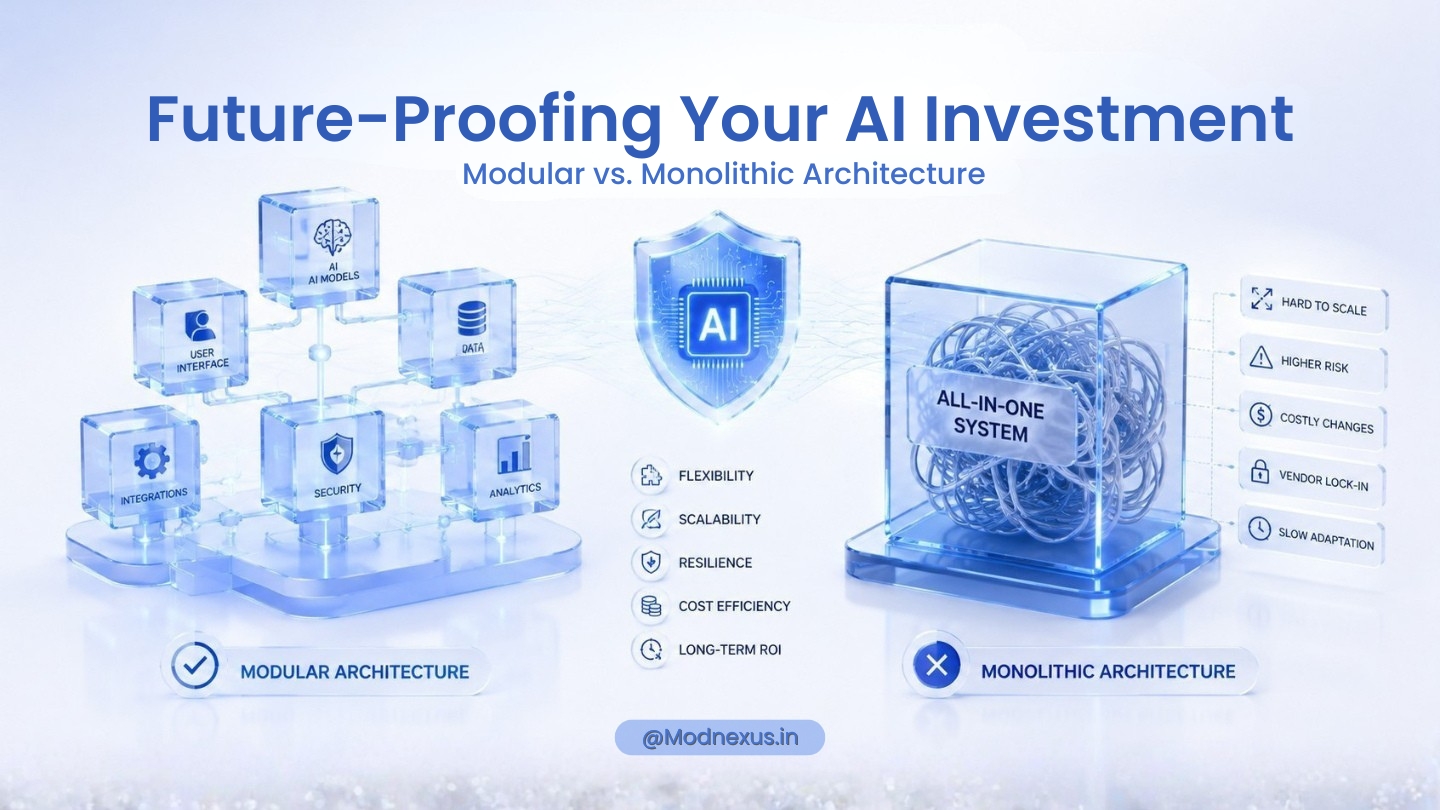
A monolithic AI system can be attractive during the early stages because it is relatively straightforward to build. A single application may contain the user interface, prompts, business logic, model integrations, retrieval pipeline, agent workflows and external integrations.
That approach can work for a proof of concept.
However, as an AI system becomes business-critical, tightly coupling all these components can make future changes increasingly expensive.
A modular AI architecture takes a different approach. It separates important capabilities into independently managed components, allowing organizations to replace or upgrade models, retrieval systems, agents, data pipelines and integrations without redesigning the entire platform.
This does not mean that every enterprise should immediately turn its AI application into dozens of microservices. Over-engineering is its own form of technical debt.
The real objective is more practical:
Build clear boundaries around components that are likely to change.
That is what makes an AI investment more resilient.
A monolithic AI system generally places multiple capabilities inside one tightly connected application.
A typical enterprise AI application might look something like:
User Interface → Application Logic → Prompt Logic → LLM → RAG → Database → Business Integrations
At first glance, this can be efficient.
A development team can build one application, deploy it as one service and maintain a relatively small number of infrastructure components.
For a narrow use case, that simplicity can be valuable.
Imagine a manufacturing company wants an internal AI assistant that answers questions about product specifications. The initial application might connect a frontend directly to an LLM, retrieve documents from a knowledge base and return answers to employees.
If the system remains small, there may be little reason to introduce additional architectural layers.
The problem appears when the system becomes strategically important.
Suppose the company later wants to:
If all these capabilities are deeply embedded into the original application, every change can affect multiple parts of the system.
This is the fundamental weakness of a monolith:
Components that should evolve independently become dependent on one another.
AWS Prescriptive Guidance similarly recommends decomposing complex generative-AI applications into modular, reusable services because monolithic implementations can become brittle, difficult to test and risky to update.
A modular architecture separates an AI platform into components with clearly defined responsibilities.
A simplified enterprise architecture might look like:
User Interface
↓
API / Application Layer
↓
AI Gateway / Model Router
↓
Agent Orchestration
↓
Models + Retrieval + Tools
↓
Enterprise Systems
The important point is not the exact number of layers.
It is the separation of responsibilities.
For example, the model router should decide which model is appropriate for a task. The application should not contain hundreds of direct dependencies on a particular model provider.
Similarly, a retrieval service should manage document ingestion, chunking, embeddings and retrieval rather than embedding all of that logic into every AI agent.
A modular design could therefore contain:
These components can still be part of one product.
Modularity does not necessarily mean creating 20 separate applications.
It means creating boundaries so that important components can change without causing unnecessary changes elsewhere.
AWS describes similar patterns for production generative-AI systems, including dedicated ingestion services, model abstraction services, orchestration services, memory services and gateway services.
Traditional enterprise software can remain relatively stable for years.
AI is different.
The underlying technology is moving quickly, which means architecture decisions made today can become constraints much sooner than expected.
Consider the lifecycle of an enterprise AI application.
In year one, the organization may choose one model because it offers the best combination of capability and cost.
In year two, another model may offer better reasoning.
A smaller model may become significantly cheaper for routine tasks.
A local model may become attractive for confidential workloads.
A multimodal model may become necessary for processing documents, images or video.
An agentic framework may provide better orchestration.
A different retrieval technology may provide better search quality.
If the architecture is modular, the organization can evaluate these options independently.
If the architecture is tightly coupled, every technology decision becomes an application redesign problem.
This is why future-proofing does not mean predicting the future.
It means designing the system so that you don’t have to predict it perfectly.
These concepts are related but not identical.
A company might use one cloud provider while remaining relatively model-independent.
For example, an enterprise could use a cloud AI platform that provides access to multiple models. The application interacts with an internal AI gateway instead of directly calling each model provider.
The application might send:
Task = summarization
Required quality = high
Latency target = <2 seconds
Data classification = internal
The model router then selects an appropriate model.
This creates a useful abstraction.
The business application cares about the capability it needs.
The infrastructure layer determines how that capability is delivered.
Modern enterprise AI platforms increasingly reflect this model-catalog approach. Microsoft’s current architecture guidance, for example, describes access to multiple foundation-model providers and emphasizes model selection, RAG, context engineering and agent architectures as parts of modern AI systems.
The principle can be implemented independently of any particular cloud vendor.
One of the simplest ways to make an AI system more flexible is to establish clear interfaces between components.
Consider a customer-support application.
Instead of having the application directly depend on a specific LLM SDK, create an internal AI service.
The application sends a request such as:
Generate a customer-support response using the relevant policy context.
The AI service handles:
Now the application does not need to know which model generated the answer.
If the model changes, the application can remain unchanged.
This separation is particularly valuable when several internal applications consume the same AI capability.
For example, a large insurer could have:
Rather than allowing each application to implement model integrations independently, the organization can centralize common AI capabilities.
This reduces duplication and makes governance easier.
A future-ready AI architecture should also recognize that different tasks have different requirements.
A simple classification task does not necessarily require the most powerful reasoning model available.
Likewise, a complex financial-analysis workflow may justify a more capable model.
A model-routing layer can therefore assign workloads according to:
For example:
Customer FAQ → Small/fast model
Complex contract analysis → High-reasoning model
Sensitive internal workflow → Approved private deployment
Document embedding → Dedicated embedding model
Image inspection → Vision model
This approach can improve both cost efficiency and resilience.
More importantly, it allows organizations to experiment.
A company can test a new model on a controlled percentage of workloads before making a broader migration.
Retrieval-Augmented Generation, or RAG, is another area where tightly coupled architecture can create problems.
A typical RAG pipeline includes:
Data Sources → Ingestion → Processing → Chunking → Embeddings → Index → Retrieval → Context → Model
If all of this logic is embedded inside one application, changing the retrieval technology can become difficult.
A modular design treats ingestion and retrieval as dedicated capabilities.
For example, a manufacturing company may have product manuals, engineering drawings, ERP records, quality documents and service reports.
The ingestion layer can normalize those sources.
The retrieval layer can determine what information is relevant.
The model layer can then reason over the retrieved context.
This separation also supports multiple applications.
The same enterprise knowledge layer could potentially serve:
Microsoft’s current AI architecture guidance similarly emphasizes RAG and context engineering as architectural capabilities for grounding AI applications in enterprise information.
The rise of AI agents creates another architectural challenge.
Organizations sometimes begin with one agent and continuously add responsibilities to it.
Eventually, the agent may be responsible for:
At that point, the “agent” is effectively becoming another monolith.
A better approach is to define agents around business capabilities.
For example:
Sales Agent
Responsible for lead qualification, product recommendations and CRM interactions.
Document Agent
Responsible for extracting and validating information from documents.
Support Agent
Responsible for troubleshooting and knowledge retrieval.
Finance Agent
Responsible for approved financial workflows.
An orchestration layer can coordinate these capabilities when a business process requires multiple agents.
This makes testing, permissions and monitoring much easier.
It also creates a safer environment for introducing new capabilities.
Modularity is not only about software engineering.
It can also improve governance.
Enterprise AI systems frequently process sensitive information.
That may include customer records, financial data, employee information, contracts, intellectual property and operational data.
A modular architecture allows security controls to be applied at specific boundaries.
For example:
This is important because trustworthy AI is broader than model accuracy.
NIST’s AI Risk Management Framework identifies characteristics including validity and reliability, safety, security and resilience, accountability and transparency, explainability and interpretability, privacy enhancement, and fairness with harmful bias managed.
NIST also emphasizes that AI risk management should cover the lifecycle from design and development through deployment, use, testing and evaluation.
That makes architecture an important part of AI governance rather than simply an engineering concern.
Consider a manufacturer with several plants and a large technical-document repository.
The company wants an AI assistant capable of answering questions about:
A monolithic system might connect everything directly to one model.
A modular system could separate:
Document ingestion
↓
Knowledge and retrieval service
↓
AI gateway
↓
Technical-support agent
↓
ERP / maintenance systems
Now imagine the manufacturer wants to introduce image-based fault detection.
The organization does not necessarily need to rebuild the knowledge platform.
It can introduce a vision capability as another service.
Similarly, if a new model performs better on technical reasoning, the model layer can be updated independently.
The business capability remains stable even while the underlying AI technology evolves.
Financial institutions face a different set of requirements.
An AI assistant might need to retrieve policy documents, analyze customer information and interact with internal systems.
But the organization may not want every AI workflow to access every data source.
A modular architecture allows permissions to be defined around specific tools and agents.
For example:
Customer-service agent → approved customer data
Compliance agent → regulatory knowledge base
Credit-analysis agent → approved financial information
Employee assistant → internal policies
The AI gateway can also enforce model-selection rules.
Highly sensitive workloads may be routed to approved environments, while lower-risk workloads may use other models.
The architecture therefore becomes part of the institution’s risk-control framework.
Healthcare demonstrates why modularity needs to be paired with governance.
Consider a healthcare organization building AI capabilities for document summarization, clinical knowledge retrieval and administrative automation.
These are not identical problems.
A summarization model, retrieval system and workflow automation agent may require different validation processes.
Keeping them modular makes it easier to define separate:
The objective is not simply to make the system technically flexible.
It is to make the system controllable.
That distinction matters in high-impact environments.
A large retailer might use AI across:
There is little reason for all of these workloads to use the same model.
A recommendation system may rely on one class of models.
A conversational assistant may use another.
Product descriptions may use a lower-cost generation model.
Forecasting may rely on statistical or machine-learning models rather than an LLM.
A modular architecture lets the business choose technology according to the business problem rather than forcing every capability through one AI stack.
The biggest cost of a monolith is not necessarily its initial development.
The bigger cost can emerge later.
Consider a hypothetical enterprise that spends ₹1 crore building an AI platform.
Two years later, the company discovers that its current model is no longer optimal.
If the model layer is isolated, migration may be primarily an evaluation and integration exercise.
If the model is embedded throughout the platform, migration can involve:
The organization is effectively paying a switching cost.
This is why the financial value of modularity should be measured by the cost of future change, not just today’s development cost.
When evaluating an AI investment, businesses often calculate:
ROI = Benefits − Initial Implementation Cost
That is necessary, but incomplete.
For long-lived AI systems, leadership should also consider:
Total Cost of Ownership = Build Cost + Operating Cost + Maintenance Cost + Change Cost + Switching Cost
The final two components are frequently underestimated.
A system that costs ₹30 lakh more to build today but saves ₹50 lakh during future migrations may be economically superior.
Conversely, building an elaborate microservice architecture for a small internal chatbot may create unnecessary expense.
Therefore, modularity should be applied strategically.
Architect for change where change is likely.
Consider a hypothetical manufacturing organization that built an AI platform around its original operational requirements.
The first version successfully handled document retrieval and employee questions.
Over time, the organization wanted to introduce:
Because the original system tightly coupled its model, prompts, data processing and workflows, the proposed changes created significant architectural dependencies.
An internal assessment estimated that a full redesign could cost approximately ₹50 lakh.
Instead of replacing the entire platform, the organization redesigned the architecture around independent AI services.
The model layer became replaceable.
The retrieval layer became independently managed.
Agents received defined responsibilities.
Business integrations were separated from model logic.
The ₹50 lakh figure here should be treated as an illustrative enterprise scenario, not a claim about a specific named customer.
The broader lesson is what matters:
AI technical debt can become a financial liability when it prevents an organization from adopting better technology.
There is an important warning here.
Modular does not mean that every function needs its own microservice, container or Kubernetes deployment.
Over-engineering can create:
For a small AI application, a modular monolith may be the right answer.
A modular monolith can maintain clean internal boundaries while remaining one deployable application.
As the system grows, selected components can be extracted into independent services.
This is often a more practical path for mid-sized businesses.
The architectural principle should therefore be:
Loose coupling first. Distributed deployment only when justified.
Vendor evaluation should go beyond model benchmarks.
Ask architectural questions.
If changing the model requires rewriting the application, understand the migration implications before signing.
A platform that supports model diversity may provide more flexibility than one designed around a single model.
This matters if your organization expects to use private, open-weight or specialized models in the future.
Understand data residency, retention, access controls, logging and provider policies.
Ask whether you can export:
Proprietary interfaces can increase switching costs.
This becomes increasingly important as the platform grows.
A strong vendor should be able to explain the exit process clearly.
This is not an anti-vendor approach.
It is basic enterprise risk management.
A good technology partner should make it possible for your organization to remain in control of its architecture.
One of the most overlooked components of future-proof AI is evaluation.
You cannot safely replace one model with another simply because the new model performs better on a benchmark.
Your enterprise needs to know:
Does the new model perform better for our actual workloads?
Create representative evaluation datasets for important use cases.
For example:
Customer service
Document extraction
RAG
Agents
Now when a new model arrives, you can test it against your existing baseline.
This turns model migration from a risky technology project into a measurable engineering process.
A modular system without observability is still difficult to manage.
Organizations should monitor:
An AI gateway can provide a centralized point for many of these controls.
This also makes it easier to compare models.
For example, if Model A produces slightly better answers but costs three times as much and has double the latency, the business can make an informed decision.
Future-proofing requires data about system performance.
A mature enterprise AI platform could eventually look like:
Experience Layer
Web apps, mobile applications, employee portals and chat interfaces.
↓
API & Identity Layer
Authentication, authorization, rate limiting and API management.
↓
AI Gateway
Model routing, provider abstraction, policy enforcement, cost controls and logging.
↓
Orchestration Layer
Workflow management, agent coordination and tool execution.
↓
AI Capability Layer
Specialized agents, classification, summarization, extraction, reasoning and generation.
↓
Knowledge Layer
Document ingestion, search, RAG, vector databases and enterprise knowledge.
↓
Model Layer
Cloud models, private models, open-weight models and specialized models.
↓
Enterprise Systems
CRM, ERP, HRMS, databases, document management and business applications.
↓
Governance & Observability
Evaluation, monitoring, security, audit logs, human approval and compliance.
This architecture does not need to be implemented all at once.
A company can start with a few well-defined boundaries and expand them as the AI portfolio grows.
Before designing the architecture, identify components likely to evolve.
Models are highly likely to change.
Prompts will change.
Retrieval technology may change.
Business workflows may change.
Enterprise systems may change.
Design boundaries around these areas.
Your business rules should not depend unnecessarily on the implementation details of an LLM.
The business application should express what needs to happen.
The AI layer should determine how AI capabilities are used to accomplish it.
Avoid scattering model-specific API calls throughout the application.
Centralize model interaction through a controlled abstraction layer.
This creates a foundation for experimentation and migration.
Do not wait until your first model migration to establish benchmarks.
Create evaluation datasets while the system is being developed.
This gives you a baseline against which future models can be compared.
Every significant AI investment should answer:
If this vendor disappeared tomorrow, how much of our system would we have to rebuild?
That question exposes hidden dependencies.
The lower the replacement cost, the more resilient the architecture.
Before approving a major AI investment, leadership should be able to answer:
If several answers are “no,” the organization may already be accumulating AI-specific technical debt.
The goal of future-proofing is not to build an architecture that never changes.
That is impossible.
The goal is to build an architecture that can change safely and economically.
A model will eventually be replaced.
A database may eventually be replaced.
An agent framework may eventually be replaced.
A cloud service may eventually be replaced.
Business requirements will certainly change.
The organizations that handle these changes well will not necessarily be those that selected the most powerful AI model at the beginning.
They will be those that designed their systems around change.
Modular architecture provides that flexibility.
It enables organizations to experiment with new models without immediately rewriting their applications. It allows specialized agents to evolve independently. It supports multiple AI capabilities across different business functions. It can improve governance by creating clearer control points for security, evaluation and monitoring.
Most importantly, it changes the economics of innovation.
Instead of asking:
“How much will it cost us to replace the entire AI platform?”
leadership can ask:
“Which component should we replace, and how quickly can we do it?”
That is a fundamentally different position.
Enterprise AI investments should be designed with the assumption that today’s technology will eventually change.
That is not pessimism.
It is good architecture.
A monolithic AI application may still be the right choice for a small, well-defined use case. But as AI becomes embedded across customer service, operations, sales, finance, manufacturing and knowledge management, tightly coupled systems can make innovation increasingly expensive.
Modular architecture offers another path.
Separate the model from the application.
Separate retrieval from generation.
Separate agents by responsibility.
Separate business integrations from AI logic.
Create evaluation and observability layers.
Control data and permissions at clear boundaries.
And most importantly, avoid allowing one technology provider, model or framework to become inseparable from the business capability you are building.
NIST’s AI Risk Management Framework reinforces the broader principle that trustworthy AI requires attention to reliability, security, resilience, accountability, transparency, privacy and other characteristics throughout the AI lifecycle.
The future of enterprise AI will not be determined only by which model has the highest benchmark score.
It will also be determined by how easily organizations can adopt the next model, the next agent framework, the next retrieval technology and the next generation of AI infrastructure.
The best AI architecture is not the one that assumes the future will look like today.
It is the one that gives your business the freedom to change when the future arrives.
If your organization is investing lakhs or crores in AI, evaluate architecture as carefully as you evaluate model capability.
A powerful model can improve an application today.
A modular architecture can protect the investment for years.
Don’t build an AI system around today’s technology. Build an AI platform around tomorrow’s ability to change.