
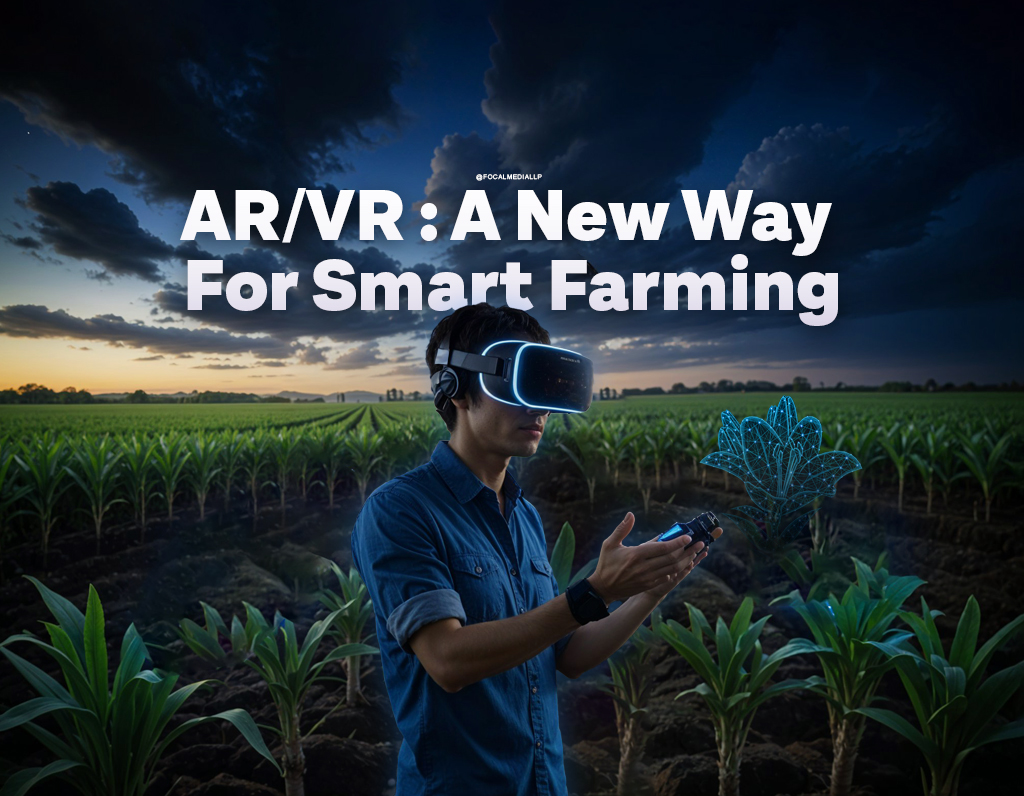

In today’s world, every sector is changing due to the advancement of technology. It is, therefore, fulfilling to argue that the most potential idea in the contemporary innovation sector is the incorporation of AR/VR in agriculture. They range from the simplest ways that farmers alter how they produce food right to the highest level of how they relate to the earth. Now, let’s learn how AR/VR is introducing a smarter way to agriculture.
What Is AR/VR?
AR (Augmented Reality) and VR (Virtual Reality) are two technologies that are rapidly developing. AR places digital images on top of the real environment. VR provides an environment in real space but in a virtual world. All of these tools, if put together, could bring a massive change in the farming industry.
AR/VR in Precision Farming
Precision farming is the application of information to increase the efficiency of farming. AR/VR gives farmers real-time 3D land data. This assists in supervising the state of crops, nature of soil, and climate conditions as well as parish to the grounds. AR/VR helps to make these tasks easier, more precise, and quicker.
Farmers can virtually inspect crops, check for pests, and assess farm health using AR/VR. Instead of having to walk through fields and have instructors physically stop them: They can use AR glasses/VR headsets and get immediate feedback. This means they can immediately enable measures to eradicate any hurdles with crop yield thus minimizing losses.
Training and Education with AR/VR
Training new farmers or even educating current farmers is another area where AR/VR delivers the best results. As it is practiced in conventional farming, training is normally hands-on training. However, with XR, new farmers can practice in an imitation world. They can perform such activities as planting or harvesting, or even exercising on the use of certain machines without damaging crops.
AR/VR helps agri schools simulate farming scenarios. Students can learn what it feels like to deal with crops, animals, or equipment. Familiarizing students with virtual simulations in training can be an effective way of teaching without the huge costs or dangers of a real environment.
Farm Management with AR/VR
Managing a farm involves several tasks, from planting to harvesting. With XR(Mixed Reality), farmers can manage everything from one location. They can use AR/VR tools to visualize their entire farm, track the growth of crops, and even predict harvest times.
Farmers can also use these technologies to simulate different farming conditions, such as weather changes or new planting methods. This helps them to make informed decisions before applying changes in the real world. As a result, XR(Mixed Reality) leads to better planning, resource allocation, and time management.
Monitoring Crops with AR/VR
Supervision of crops is considered one of the most important tasks for farmers around the world. Using AR/VR, this process can be done in a much more efficient way since farmers can easily visually interpret data. For instance, using AR, farmers can check the health delivery of crops on their mobile phones or AR glasses. It also allows farms to early detect problems such as pest attacks or diseases before they become severe.
Other areas of application of AR/VR are pest and disease detection or assisting in irrigation management. Water has to be used efficiently, and the goal of visualizing the data concerning the soil moisture and crop needs will help farmers achieve it. This does not only save water but also makes sure that the crops required are well irrigated.
Livestock Management
Agriculture is much more than the production of crops; it also includes raising animals. XR(Mixed Reality) is also enabling farmers to monitor the overall health status of animals. Livestock monitoring is made possible in real-time using the AR tools available to the farmers. Some of them, for example, can monitor the pulse rate or body temperature, as well as activity.
VR simulations also help farmers practice managing livestock that may be present either at the farm or in the fields. This training can include methods involving: breeding, feeding, or handling animals that are sick. Earlier, farmers were forced to go by experiences. Through AR/VR they get the opportunity to rehearse and enhance their performance in a secure environment.
Increased Efficiency in Farming Operations
Farmers engaged in these farming operations always face several challenges at the same time. XR saves time on training by sharing tasks. For instance, when using farming machinery, AR can guide farmers in the exact manner they should perform tasks with the help of a sequence. They can also make use of VR to create a diverse setting of the machinery before coming up with a decision taking into consideration the simulation results.
Also, some of the application areas of AR/VR are in equipment maintenance. Instead of waiting for a technician to come around, farmers can use AR to solve problems on machines independently, and even know how to fix them. This has the advantage of often making sure that the equipment is mostly in use, and in good condition from earlier use.
Remote Assistance Using AR/VR
The biggest strength of implementing AR/VR is definitely the possibility of providing remote support. In rural communities, the owners of agricultural lands hardly get professional advice and support. With XR they can meet with experts who can assist them in real time. When it comes to machine faults or crop issues, for example, specialists can use AR/VR and guide the team on-site without physically being there.
For example, if a farmer has a problem with a machine the latter will be able to put on an AR headset that will enable an expert to see the situation from the farmer’s angle. The expert can then give the instructions and at times can even take one through the process of repairing the system. This technology helps to close the gap and get the farmers the support they require from experts who may be many miles away.
Sustainable Farming with AR/VR
Sustainability has been central in practicing contemporary agriculture. AR/VR is useful in enhancing the making of farming more sustainable. They assist farmers in better using the available resources, avoiding waste, and having low VP impacts on their business.
According to the (AR/VR) technology, it makes it easier for farmers to check the status of the crops as well as the soil and water usage. For example, if the amount of soil moisture is high, there is no point in irrigating the crops. This as a result cuts down on water use, a problem that is prevalent in most areas of the world. In addition, AR/VR can assist farmers to minimize the use of pesticides as they aid in the early detection of pests eliminating the need to use chemicals.
The Future of Farming with AR/VR
The possibilities for applying AR/VR in the agri-food chain are still emerging. As technology advances, these tools will become more effective. They will provide farmers with even higher levels of data, analytics, predictive systems, and automation. AR/VR will not only increase efficiency but will also ensure that the efficiency seen in agriculture is environmentally friendly in the long run.
In the future, AR/VR could be combined with AI and IoT into a unified technological system to increase the efficiency of business processes. In combination, these tools may design smart farms that are fully autonomous and self-sustaining. Farmers would interfere occasionally, hence minimal hire costs and high efficiency.
Challenges in Implementing AR/VR in Farming
There are however some limitations that have impounded the implementation of AR/VR in the market as presented below. Such one of the main shortcomings, the cost factor is a key consideration in the development of a mobile application. AR/VR equipment may be costly, and the farmers may not afford to buy any of the technologies.
The other difficulty is the absence of properly developed infrastructure in rural regions. Due to the need for tracking and rendering of information in real-time, augmented and virtual reality applications typically demand high-speed internet, and/or more processing power”. Farmers may not be able to fully capture all these technologies due to a lack of reliable connectivity.
Consequently, education and training emerge as another requirement. As we have found, the potential of AR/VR in agriculture is huge, yet the farming community may remain largely unaware of how to use it. Therefore, education and training will form a core foundation for realizing the application of AR/VR in agricultural practice.
Conclusion
AR/VR adoption in farming is proving to be the key to a new age of optimized techniques in farming. These technologies assist farmers in crop supervision, livestock control, training enhancement and decision making. In conclusion, as AR/VR develops the technology is to be expected to strengthen and become an important parameter in farming around the globe. With the potential to boost productivity and sustainability, AR/VR will play a key role in shaping the future of agriculture.