
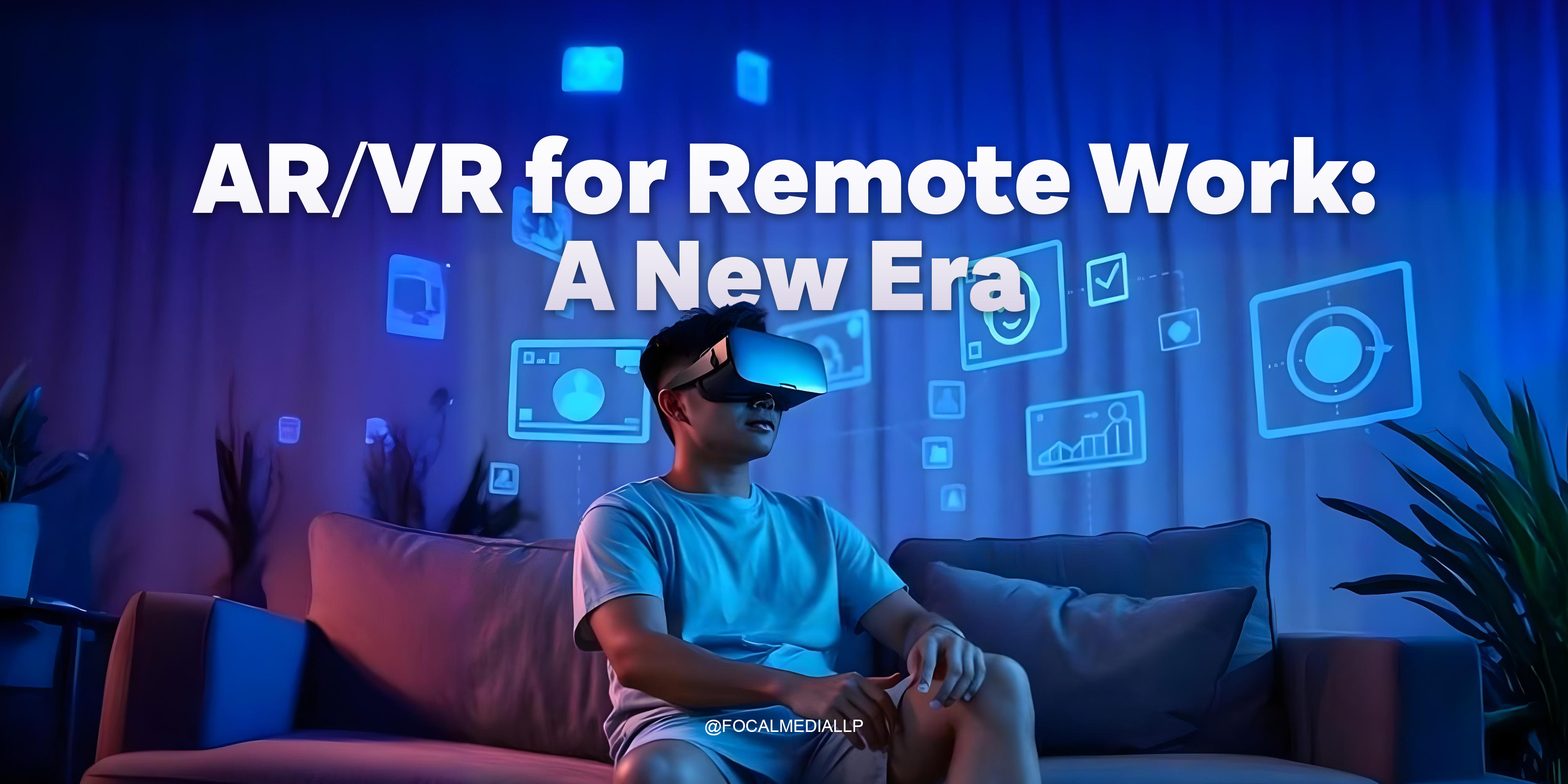

Telecommuting is quickly becoming popular globally. In recent years it has become the standard model for many industries. In this regard, the new forms of communication such as Zoom, Microsoft Teams, and Slack perfect the shift. However, these tools still have their limitations in simulating the real work experience of the candidates. Well, welcome AR (Augmented Reality) and VR (Virtual Reality) – technologies that are changing the meaning of remote work. AR/VR has the potential to close the gap between virtual and physical working environments and can support more engaging and realistic remote collaboration.
What is AR/VR?
Now, it would be pertinent to discuss what AR/VR means before we move a step forward to understand their effects on remote work. Augmented Reality (AR) puts additional computer-generated information on an existing scene. Just as in Pokémon GO or those filters on SnapChat – the two overlay something on what we see. Virtual Reality (VR), on the other hand, environments are completely created virtually. VR headsets like Oculus Quest or HTC Vive are examples that let users go into completely virtual environments. The two technologies make it possible to have experiences within the environment but in different ways.
The Need for Immersive Remote Work Solutions
The conventional organizational structure has advantages that absent themselves in remote work. All of them can chat with each other, come up with ideas in face-to-face conversations, and even get to know one another. Remote working, as wonderful as it is, can sometimes completely miss out on these qualities. This is where AR/VR steps in. It improves communications, participation, and to an extent, work efficiency for people working away from the office. AR/VR can present many opportunities to enhance remote work, which exists and will continue to exist to a significant extent even after the COVID-19 pandemic is over, mainly by making virtual work environments more dynamic.
How AR/VR Elevates Remote Work
1. Virtual Meetings That Feel Real
Even though virtually all the businesses have engaged in virtual meetings instead of face to face via video calls, it is often shallow. Meetings are not the same anymore with the use of AR/VR. Colleagues can be presented in virtual meeting rooms via VR. They see the avatars of their colleagues, and this gives some feeling of presence. For example, while using Facebook, and Horizon Workrooms, they are able to get into virtual offices. And it is so different from the flat call experience that people are used to with video calls.
2. Collaborative Whiteboards and 3D Models
People who work remotely often need some illustrations for effective collaboration. AR/VR allows for distributed illustrated collaborative ideation on such tools as ideation boards. It also permits 3D models and this assists in viewing the prototypes and manipulating them. Spatial and Microsoft Mesh have integration features for designing and evaluating objects in a common area. These platforms encourage freedom of expression because individuals are not limited within a certain time constraint of showing every idea on camera.
3. Enhanced Training and Skill Development
Training is essential, more so if the employees are newly hired or if the organization wants to improve employees’ skills. Regardless of the above-discussed implementing approaches, there is no denying that AR/VR provides training possibilities that conventional tactics cannot provide. For instance, an employee can onboard themselves through a virtual reality session. They can familiarise themselves with the actual environment and can learn more about organizational culture through a simulated tour. Other big companies like Walmart and UPS have empowered their employees with virtual reality training for exposure to real-life events. This is especially true if the training involves jobs that require the use of practical skills such as operating large machines.
4. Immersive Project Management and Planning
Communication and visualization also play important roles in project management where project managers play a vital role. AR/VR can help project managers to model projects based on an ideal model of projects. They can monitor phases and vices, and vice versa without physically visiting the site of construction. This is particularly helpful in construction or manufacturing because of the carefully designed layouts of elements and principles. AR/VR enables the project managers to see the model and designs in 3D hence improving remote planning.
5. Social Interaction and Team Building
The social relations can hurt due to remote work and negative consequences may result in reduced morale and productivity of the team. Thus, AR/VR may help to restore the social component. Businesses can always plan virtual reality-based crew-building exercises. People can assemble virtually to play games or to commemorate certain accomplishments. VR social apps also include AltspaceVR through which employees can casually communicate or converse with each other. These interactions foster team development more so given that people could be working from different time zones.
6. Remote Assistance and Troubleshooting
AR, in particular, is best useful for distant diagnosing of problems and issues. Technicians can even instruct users in real-time and have instructions pop up in the real world. When a user is donning AR glasses, they may be given instruction from an expert one step at a time. This approach is efficient in organizations such as manufacturing organizations because early troubleshooting is crucial. Examples of applications of AR in today’s society include remote support services as in TeamViewer Pilot.
Key Benefits of AR/VR in Remote Work
1. Reduced Travel Costs
AR/VR can do away with regular physical conferences which, can save much on traveling costs. One of the alternatives to an expensive and time-consuming journey is a VR meeting. This benefit goes as far as training and inspections which have always necessitated physical presence. AR/VR facilitates users’ interaction in a way that does not require physical presence and preserves the quality of the process.
2.Improved Engagement and Retention
Normal video communications can be rather draining, getting into the “Zoom, fatigue” territory. Whereas traditional calls do not have the same creative spin as AR/VR does. In VR, the participants are more immersed, and so meetings are much more interesting. This assertion indicates that organizations that have engaged employees will likely have high productivity and a high level of organizational commitment.
3. Increased Productivity
AR/VR can only improve focus because it allows users to have a separate virtual working environment. One particular benefit of VR users is that they can easily eliminate interference and focus only on work. The flexibility offered in the application of AR/VR also impacts productivity in that the interaction of the two keeps everyone at work, particularly in the group.
4. Better Communication and Collaboration
Since there is little face-to-face contact, misunderstandings occur frequently in jobs that are done remotely. As in a face-to-face manner, misunderstandings are dealt with due to the use of an AR/VR connection. Group members can explain one another’s project progress on a single board, and the ideas become easier to understand.
Challenges and Limitations of AR/VR in Remote Work
1. High Equipment Costs
This means quality VR headsets & AR devices are still expensive. If anything prices of equipment that support AR/VR are going down, however, the prices always stay high since it is an investment. On this account, this can be a restrictive factor for entry for small businesses.
2. Bandwidth and Technical Requirements
AR/VR calls for the use of the internet since it is one of the essential requirements in the running of a firm. This can cause lag and/or buffering which will increase the detriments to the extent of compromising the VR experience. However, some of them may not be able to get access to a high-speed internet connection. These are some of the limitations that firms have to deliberate before adopting AR/VR.
3. User Comfort and Health Concerns
While using the VR headsets, wearers can develop motion sickness or discomfort in case they use them for some time. Certain people continue to complain of eyestrain or headaches after they use VR often or for long durations. Such health issues can reduce the length of time in which people spend in virtual reality-based meetings or training.
4. Learning Curve
For this reason, people are not familiar with AR/VR technology. This can mean that some of the people that you have in your organization will require some time before they can get used to new tools. Employers and companies have to provide guidance and training programs that put people at ease.
Future of AR/VR in Remote Work
AR/VR in remote work will have a better Future. Increased technology will help in making the AR/VR solution more affordable. H MDs will soon be able to wear lightweight VR glasses and AR contact lenses. These developments could turn AR/VR into one of the standard tools of remote work environments. AR/VR is one of the technologies that is in the development phase; many companies are investing in it, such as Meta, Microsoft, and Google. This investment shows greater convergence into a more digitized work environment.
There is another effective trend, which is the combination of AI and AR/VR. AI would also be able to execute responsibilities within virtual reality spaces thus increasing the efficiency of remote work. This can be visualized as an AI-based virtual driver of meetings or project timekeeping. Merging Artificial Intelligence with AR/VR can make a great impact on the efficiency of the remote working environment.
Industries Leading the Way in AR/VR Remote Work
1. Manufacturing
AR is most valuable in the manufacturing process since it provides remote support and monitors work quality. AR helps supervisors to monitor the processes remotely so as to improve their effectiveness.
2. Healthcare
Telemedicine has seen a boost with AR/VR, enabling doctors to consult with patients remotely. Surgeons can even practice complex procedures in VR, improving patient care.
3. Real Estate
Virtual Reality has revolutionized the way property viewings are done. It can be noted that buyers can access properties wanted by visiting without physically visiting the premises. The area coverage option is particularly helpful to those clients who are moving to new cities.
4. Education and Training
Schools and companies are using virtual reality systems to enhance the learning environment and make the classrooms virtual. Education is not left behind when it comes to being touched by the incident, students can even learn interactively from home.
Getting Started with AR/VR for Remote Work
If your company is only considering implementing AR/VR, don’t rush into it, rather take baby steps. Start with VR meetings to evaluate the effects of the technology to the interaction of teams. Ensure that they have worked at optimum cost so that your company can be able to afford them. The platforms are Spatial, Engage, or Horizon Workrooms research. Both are vastly different and hold some features that may suit a business type of the market as against the other. Moreover, guarantees that employs are well-trained to handle and use the above tools of project management.
Conclusion
AR/VR has shown a new dimension in remote working. Interactive, including meetings, and training, remote communication is boosted by these technology advancements. Nonetheless, although it’s not without challenges, the effectiveness of AR/VR remains great. Thus, AR/VR can become a new way of perceiving remote work that concerns not only its effectiveness enhancement but also the quality of the interactions between representatives of different organizations. Implementing AR/VR now also has a potential to provide a competitive advantage in the future, so businesses should consider it. What’s new is that this is not your typical remote work – it’s live and it’s 3D.